Sikkandar Malai: How a Fallen Sultan Became a Saint at Thiruparankundram
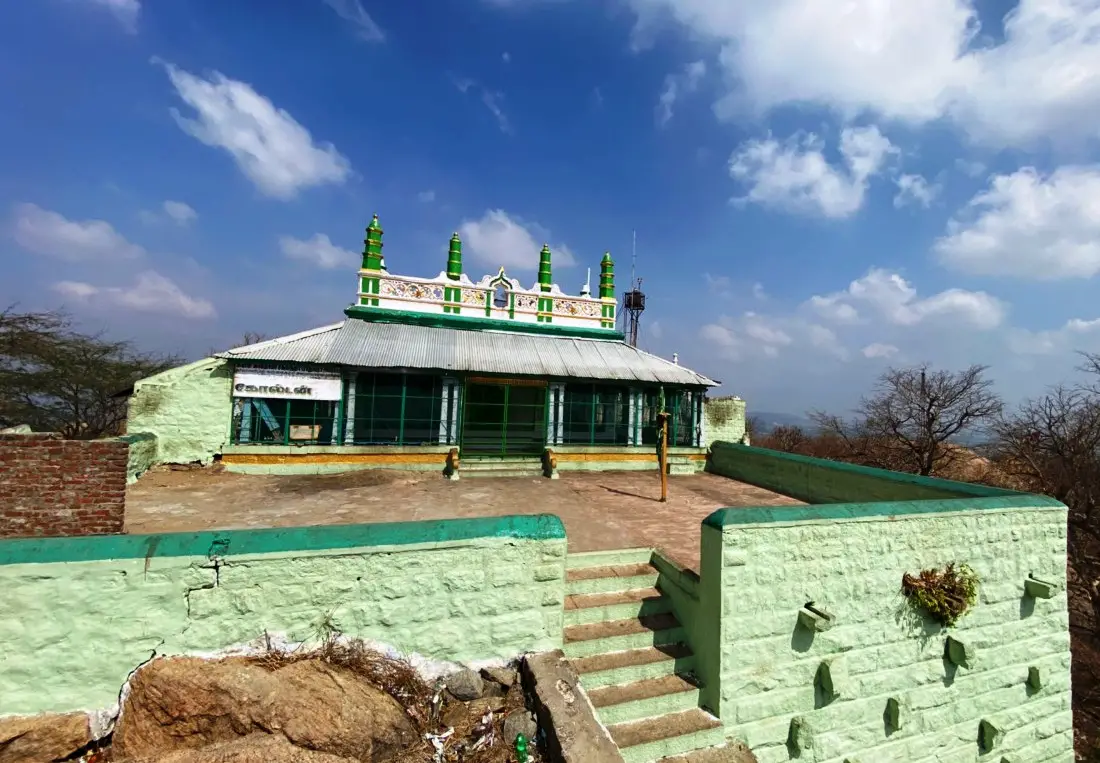
Thiruparankundram hill sits on the edge of Madurai, and most people who climb it come for one reason. They come for the Murugan temple carved into the rock face, one of the six sacred abodes of the war god and a pilgrimage site older than most nations. Far fewer visitors notice a second shrine on the northeastern slope, a small dargah shaded by neem trees and marked with a green flag. Locals call the hill itself Sikkandar Malai, Sikandar’s Hill, and the name alone tells you something happened here whose memory has outlasted an empire.
The man buried on that slope was Sikandar Shah, the last ruler of the Madurai Sultanate. He died in battle on this hill sometime around 1378, and within a generation his grave had become a place of pilgrimage. Hindus and Muslims still visit it today, six and a half centuries after a war that ended one kingdom and secured another. The story behind that grave is really three stories folded into one: a political history of conquest and collapse, a literary account written by the winning general’s own wife, and a devotional legend that grew up around the loser’s memory and eventually outgrew the facts.
A Sultanate Born From Delhi’s Overreach
To understand how a Muslim sultan came to rule Madurai at all, you have to look north, toward Delhi, and toward one ruler’s obsession with controlling territory he never managed to hold.
In the early fourteenth century, the Delhi Sultanate under Muhammad bin Tughluq pushed its authority deeper into peninsular India than any northern power had managed before. Raids led by earlier commanders, including the notorious Malik Kafur decades prior, had already stripped wealth from Tamil temples and shaken the old Pandya kingdom to its foundations. Tughluq tried something more ambitious than raiding. He attempted to administer the deep south directly, organizing the region around Madurai into a province called Ma’bar, governed by officials appointed from Delhi.
The experiment failed almost immediately, and the failure had everything to do with distance. Madurai sat more than a thousand miles from the Delhi court, across terrain that made rapid communication nearly impossible. In 1335, the governor of Ma’bar, a man named Jalaluddin Ahsan Shah, declared independence and founded his own kingdom. The Madurai Sultanate was born not from a grand conquest but from a distant province deciding it no longer needed its master.
Four Decades of Blood and Broken Thrones
What followed was one of the shortest and most violent dynastic runs in South Indian history. Over roughly the next forty years, the Madurai Sultanate cycled through a long line of rulers, many of whom seized the throne through assassination and lost it the same way. Court intrigue was constant. Brothers killed brothers. Generals turned on the sultans who had promoted them.
Beyond the palace, the sultanate’s record with its Tamil subjects grew increasingly harsh. Temples across the region were plundered for their gold and gems, a pattern that had begun under Delhi’s earlier raids and continued under local sultans who needed revenue and saw little reason to protect Hindu institutions. The ritual economy that sustained Tamil society, the network of temples, endowments, festivals, and priestly households, took heavy damage during this period. Whatever legitimacy the sultanate might have built with the population it ruled, this record of plunder undercut it badly.
A kingdom built this unsteadily could not last, and by the 1370s it was clear the Madurai Sultanate’s days were numbered. The threat came from the north again, but this time not from Delhi.
Vijayanagara Answers the South
Founded in 1336, roughly the same year the Madurai Sultanate declared its independence, the Vijayanagara Empire grew quickly into the dominant Hindu power of the peninsula. Its rulers framed their expansion partly as a religious mission, a restoration of temple worship and Brahminical order in regions the Delhi Sultanate’s raids and the Madurai Sultanate’s rule had disrupted.
Under Emperor Bukka Raya I, Vijayanagara turned its full attention southward. The campaign was entrusted to his son, Kumara Kampana, a young commander who led a sustained military push through the Tamil country during the 1370s. Kumara Kampana’s forces moved methodically, reclaiming territory and, according to tradition, reopening temples that had stood closed under sultanate rule. His march culminated in a direct confrontation with the Madurai Sultanate itself.
A Queen’s Account of Her Husband’s War
What sets this campaign apart from countless other medieval Indian conquests is that we have a detailed literary account of it, written not by a court chronicler but by the commander’s own wife. Gangadevi, married to Kumara Kampana, composed a Sanskrit poem titled Madhura Vijayam, “The Conquest of Madurai.” The poem follows Kumara Kampana’s campaign in vivid, sometimes intimate detail, describing the devastation the sultanate had inflicted on Tamil temples and the restoration that followed the Vijayanagara victory.
Historians treat Madhura Vijayam with real caution. It is a work of court poetry, composed to celebrate a husband and a dynasty, and it carries all the exaggeration you would expect from that genre. But it remains one of the closest contemporary sources we have for this period, and its account of the final battle against the Madurai Sultanate lines up with what other fragmentary evidence, inscriptions and later chronicles, tells us. Without Gangadevi’s poem, much of this war would be lost to us entirely.
The Last Sultan and the Battle at Thiruparankundram
Sikandar Shah came to the Madurai throne likely in the 1370s, inheriting a kingdom already weakened by decades of internal violence and now facing a rising power to the north. Little survives about the details of his early reign. What history remembers him for is how his reign ended.
Kumara Kampana’s army met Sikandar Shah’s forces at Thiruparankundram, a hill with obvious strategic value, close enough to Madurai to serve as a final line of defense and elevated enough to offer a commanding view of the surrounding plain. The battle that followed marked the end of the Madurai Sultanate. Sikandar Shah was killed, and with his death, the only sultanate to have exercised direct rule over the far south of the Indian peninsula ceased to exist, roughly four decades after Jalaluddin Ahsan Shah had founded it.
Vijayanagara authority now extended to the southern tip of the subcontinent, a dominance that would hold, with various local chieftains and feudatories operating beneath the imperial umbrella, until the empire’s own catastrophic defeat at the Battle of Talikota nearly two centuries later, in 1565.
From Battlefield to Shrine: The Making of Sikkandar Malai
Here is where the story stops being purely political and becomes something stranger and more human.
Sikandar Shah’s followers did not simply abandon their fallen ruler on the battlefield. They buried him where he fell, on the hill at Thiruparankundram, and over time raised a memorial above the grave. That memorial grew into a dargah, a category of shrine found across the Indian subcontinent wherever a figure believed to hold spiritual stature was thought to have lived, died, or worked wonders. The transformation from defeated king to venerated presence did not happen overnight, but it happened steadily enough that the hill itself picked up his name. Sikkandar Malai has stuck for well over six hundred years.
Dargahs across Tamil Nadu have long functioned as spaces where devotional boundaries blur. Hindus, Muslims, and people who would not describe themselves in strictly religious terms at all visit these shrines together, seeking blessings, healing, or simply a sense of connection to something older than themselves. The dargah at Thiruparankundram fits this pattern closely. It draws a steady stream of devotees today, and it does so without regard for the sectarian lines that so often define how we think about medieval conflict between a Hindu empire and a Muslim sultanate.
Three Stories, One Grave
Ask five different people at Thiruparankundram who exactly lies beneath the dargah, and three different answers are a likely result. This is not unusual around shrines of this kind. Devotional memory works differently from academic history, and over centuries, the identity of a venerated figure often shifts to emphasize sanctity over politics, or myth over documented fact.
The historical record supports one identification clearly. The shrine memorializes Sikandar Shah, the last sultan of the Madurai Sultanate, defeated and killed by Kumara Kampana’s army. This account matches the timeline set out in Madhura Vijayam and fits with the broader chronology established by inscriptions and later Vijayanagara-era records.
A second tradition tells a gentler story. In this version, the figure buried here is not Sikandar Shah the sultan but “Sikandar Badushah,” a governor said to have arrived in Tamil Nadu alongside a holy man named Sultan Syed Ibrahim Shaheed Badushah, traveling from Madinah. According to this telling, Sikandar was installed as ruler of Madurai following a victory over a Pandya king, later withdrew from political life to the caves of Thiruparankundram for prayer, and died there in an act of devotion rather than defeat. This is a saint’s biography rather than a political record, and it follows a pattern common to shrine traditions throughout South Asia, where a warrior’s death is gradually reframed as a martyr’s sacrifice.
A third and considerably later tradition reaches even further, identifying the figure at the dargah with Sikandar Zulqarnain, a legendary conqueror referenced in Islamic tradition and sometimes linked to Alexander the Great, said to have traveled to Madurai during the sultanate’s rule. This version owes more to the prestige carried by the name Sikandar than to any documented event, and most historians treat it as a much later addition, layered onto the shrine’s memory by devotees drawn to a grander legend.
None of these alternative traditions hold up well against the evidence. Madhura Vijayam was composed close to the events it describes, and its account of the final defeat at Thiruparankundram is specific enough to leave little room for doubt. Kumara Kampana killed the last sultan of Madurai on this hill. That sultan’s name was Sikandar Shah. The dargah marks the spot where he fell, whatever gentler story local memory has chosen to tell around it since.
What the Fall of Madurai Meant for South India
This single battle carries weight beyond one dynasty’s ending, and the reasons why deserve a closer look. The defeat of the Madurai Sultanate closed off the only sustained period of direct Muslim political rule over the far south of the Indian peninsula. After 1378, Tamil Nadu would not see another Muslim-ruled kingdom of comparable scale until the very different political world of the eighteenth century, under the Arcot Nawabs and later British-era arrangements. The four decades of sultanate rule stood as an anomaly, bookended by Hindu political authority both before and after.
Vijayanagara’s victory also reshaped how the region’s temple economy functioned. Kumara Kampana’s campaign, at least according to Gangadevi’s account, was framed explicitly around restoring worship at temples the sultanate had shuttered or looted. Whether every detail of that restoration matches the poem’s celebratory language is a fair question for historians to debate, but the broader pattern is well documented. Vijayanagara rule ushered in a long period of temple patronage across Tamil Nadu that shaped religious architecture and endowment practices for generations.
None of this erases the complicated legacy the Madurai Sultanate left behind. Its record of temple plunder and its harsh treatment of the Tamil population it governed are well established in the historical sources. But the communities that formed around figures like Sikandar Shah after his death also produced something the political history alone cannot capture: shrines, festivals, and devotional practices that crossed the religious lines his own kingdom had sharpened. The dargah at Thiruparankundram stands as physical evidence of that unexpected afterlife.
A Hill That Has Never Stopped Being Sacred
Step back far enough, and the dargah becomes one layer in a much older story. The Murugan cave temple on the same hill dates to the early centuries of the Common Era, making Thiruparankundram sacred ground for well over a thousand years before Sikandar Shah ever set foot near it. Hindu devotion at this site predates the Madurai Sultanate by roughly a millennium, and the dargah simply added a newer, more recent layer to a hill that had already accumulated centuries of religious meaning.
This kind of layering is common across Tamil Nadu, where sacred geography rarely belongs to a single tradition. What makes Thiruparankundram notable is how clearly the layers still trace, from an ancient rock-cut shrine to a fourteenth-century battlefield to a dargah that draws pilgrims from communities the original conflict divided.
Visiting Thiruparankundram Today
The hill sits roughly eight kilometers from Madurai city and is easy to reach by road. Most visitors still come primarily for the Murugan temple, one of Tamil Nadu’s most significant pilgrimage destinations and a major stop for anyone tracing the region’s temple architecture. The dargah on the northeastern slope receives its own steady flow of devotees, with visits peaking on Fridays and during the annual Urs, the death anniversary observance common across dargah traditions, when pilgrims arrive from well beyond the immediate Madurai region.
Standing on the slope and looking out over the plain below, the fourteenth-century scene is not hard to picture. Armies would have crossed that open ground toward a hill that offered both defense and visibility, and the battle fought here ended a dynasty within a single day. The dargah itself is quiet these days, marked by its green flag, scented faintly with incense, cared for by the families who have tended it for generations. Sikandar Shah has occupied this hillside for more than six hundred years now, remembered by most who visit not as a defeated king but as a saint.
A kingdom lasted forty years. The memory carved into this hill has already outlasted it by more than fifteen times that span.
Select Bibliography
- S. Krishnaswami Aiyangar, South India and Her Muhammadan Invaders, Oxford University Press, 1921 (available via the Internet Archive)
- K. A. Nilakanta Sastri, A History of South India: From Prehistoric Times to the Fall of Vijayanagar, Oxford University Press, 1955
- Gangadevi, Madhura Vijayam (Sanskrit epic, various critical editions and translations)
- Phillip B. Wagoner, “Sultan among Hindu Kings: Dress, Titles, and the Islamicization of Hindu Culture at Vijayanagara,” Journal of Asian Studies, Vol. 55, No. 4, 1996
- Richard M. Eaton, “Temple Desecration and Indo-Muslim States,” in Essays on Islam and Indian History, Oxford University Press, 2000
Related Posts
- Madurai Nayaks: The Warrior Kings Who Rebuilt a Kingdom from Ashes
- The Later Pandyas: Rise, Glory, and Fall of South India’s Most Resilient Dynasty
- The Battle of Srirangam 1262: How Jatavarman Sundara Pandya Broke Hoysala Power on the Kaveri
- The Clash of Titans: Deciphering the Madurai-Mysore Wars
- The Fall of Madurai’s 72 Bastions and Fort Walls: The Blackburne Story
- Panni and Miyana: South India’s Afghan Military Households
- The Fall of Pondicherry: How the Third Carnatic War Ended French India

Post Comment