Fort Geldria to Fort Sadras: The Dutch in Tamil Nadu
Long before the British built Fort St. George, another European trading company had already planted forts along the Tamil coast, minted its own coins, and gone to war with three rival powers over cotton cloth. The Dutch East India Company, known by its Dutch initials VOC, ran a chain of settlements from Pulicat in the north to Tuticorin in the far south for over two centuries. Few people today associate the Netherlands with Tamil Nadu. Yet the ruins at Pulicat, Sadras, and Nagapattinam tell a different story, one of merchants who became soldiers, of temples turned into garrisons, and of a small European nation that briefly held its own coastline stretch of South India.
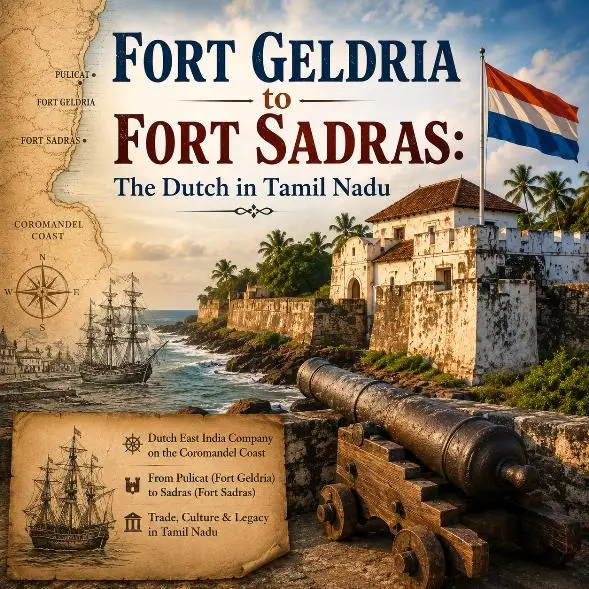
This piece traces that story from the first Dutch ship that drifted onto the Coromandel shore in 1606 to the final treaty that closed the Dutch chapter in Tamil Nadu in 1825. Along the way, this account covers the forts at Pulicat, Nagapattinam, and Sadras, the war with the Portuguese over Tuticorin and the Tiruchendur temple, the trade rivalry with the English at Madras and the French at Pondicherry, the astonishing Travancore victory at Colachel, and the final British conquest during the Fourth Anglo-Dutch War. Most of these events left almost no trace in mainstream Tamil history writing, buried instead in Dutch archival records, scattered temple inscriptions, and a handful of ruined brick walls along the coast.
How the Dutch Reached the Coromandel Coast
The Dutch did not set out to build an empire in Tamil Nadu. Their first goal lay further east, in the spice islands of present-day Indonesia. Nutmeg, cloves, and pepper drove Dutch merchants around the Cape of Good Hope from the late 1590s onward, and the United East India Company, formed in 1602, held a state-backed monopoly on that trade.
The problem was payment. Southeast Asian spice producers wanted cotton cloth, not silver coin, and the finest cotton textiles in Asia came from the weaving towns of the Coromandel Coast. Without Indian cloth, the Dutch spice trade had no fuel. This single fact explains almost everything the VOC did in Tamil Nadu for the next two hundred years.
The Company opened its first Indian factory at Masulipatnam, on the coast of modern Andhra Pradesh, in 1605. Three years later it set up a second post at Tegenapatnam. Then, in 1606, a Dutch vessel ran aground near the fishing village of Karimanal, close to Pulicat lake. The stranded sailors asked local villagers for water, and that small exchange grew into a trading arrangement with officials of the Vijayanagara Empire, which still exercised loose authority over the region. The historian Tapan Raychaudhuri, who studied Company records from this period in detail, described the Coromandel trade as the commercial backbone that kept the entire Dutch Eastern enterprise afloat during its early decades.
Pulicat and the Building of Fort Geldria
Pulicat already had a resident, and that resident was Portugal. Portuguese traders had operated along this stretch of coast since the early 1500s, and they were not pleased to see Dutch ships arrive. Tension between the two nations built for several years before the Dutch, backed by heavier armed vessels and a more aggressive commercial strategy, pushed the Portuguese out of Pulicat around 1610.
Construction of a permanent fort began soon after. The result, named Fort Geldria after the home province of the Company official who ordered its construction, rose on the shore of Pulicat lake between 1613 and 1616. A garrison of roughly eighty to ninety soldiers held the walls, a small number by European standards, but enough for a trading post whose real strength lay in commerce rather than conquest. Contemporary accounts describe Fort Geldria as the only true fortification the VOC built on the entire subcontinent. Every other Dutch post in India, including Sadras and Nagapattinam in their early years, functioned as an open factory rather than a walled stronghold.
Pulicat quickly grew into the administrative capital of what the Dutch called Coromandel, a governorate that stretched along the coast from Andhra Pradesh down through Tamil Nadu. From 1616 until 1690, every Dutch decision on this coast, whether about textile orders, coin minting, or war with a rival power, passed through the Pulicat governor’s office. The Company even opened its first Indian mint inside Fort Geldria in 1615, striking copper coins known as kas, stamped with the VOC monogram alongside a Sanskrit inscription. These coins circulated as far as Dutch Ceylon and remained in use for decades.
“Fort Geldria was for several decades a centre of Dutch power on the Coromandel coast, the seat of governance for the entire Company presence in eastern India.” — adapted from field notes on the Pulicat fort ruins
Local rulers did not simply hand the fort to the Dutch. According to the treaty signed with regional authorities, the ruler of the area was meant to help finance construction and hold a share in the fort itself. In practice, work dragged, and the Company ended up paying most of the cost from its own funds, a pattern that repeated at nearly every Dutch settlement on this coast.
Pulicat became more than a warehouse town. It housed European officials, Tamil weavers, Gujarati and Persian merchants, and a growing mixed-race community born of Dutch men and local women. Two cemeteries survive there today. The older Buitenkerkhof, or outer churchyard, held burials from every rank of Company society without distinction. A separate inner cemetery, founded in 1656, was reserved for senior VOC officials, its gravestones carved with family crests and Latin inscriptions that still stand among the coastal scrub.
The Textile Trade and the Darker Business of Slavery
Cotton cloth built Dutch Coromandel, and the Company worked hard to keep it that way. Weavers in villages around Pulicat and later Sadras produced under strict Company terms. Local manufacturers were permitted to weave only what the VOC ordered, a form of control that squeezed independent producers out of the open market. Officials called this a monopoly, and for the Coromandel textile trade, that word was close to literal truth.
The scale of production was enormous. At its height, Coromandel cloth supplied Dutch trading posts across the East Indies and filled the holds of homeward-bound fleets year after year. Chintz, muslin, and plain cotton cloth from Tamil looms turned up in markets from Batavia to Amsterdam.
A far grimmer trade ran alongside the cotton business. Independent researcher Wil O. Dijk, drawing on Company records held in the National Archives of the Netherlands, documented a sustained Dutch slave trade operating out of Coromandel ports, Pulicat among them. Historian Markus Vink’s research into Dutch slaving in the Indian Ocean world found that Coromandel slaves were often prized by Company buyers for their skill and for what contemporary Dutch writers called their disciplined temperament, a description that reveals more about the buyers than the enslaved. The trade continued into the late 1700s, running in competition with slave networks operated by the French and the English. Almost nothing about this history survives in public memory today. The ruined well inside the Pulicat cemetery, and the brick fragments hidden under thorn bushes near the bus stand, remain among the only physical traces left.

Governing a Coastal Trading Empire
Dutch Coromandel never functioned as a colony in the way the British Raj later did. The VOC held no ambition to rule vast inland territories or collect land revenue from millions of subjects. Company officials stayed close to the coast, ran their forts as fortified warehouses, and left the surrounding countryside under the authority of local Nayak rulers, Poligars, and later the Nawabs of the Carnatic, so long as trade kept flowing.
A governor based first at Pulicat and later at Nagapattinam oversaw the entire Coromandel governorate, answering upward through a chain of command that ran to Batavia, the Company’s Asian headquarters in present-day Jakarta, and from there back to the seventeen directors of the VOC board in Amsterdam. A round trip of correspondence between Nagapattinam and Amsterdam could take well over a year, which left local governors with considerable freedom to make decisions on the ground long before instructions from Europe arrived.
Beneath the governor sat a small European staff, rarely more than a few dozen senior officials at any single post, supported by a much larger local workforce of clerks, weavers’ agents, translators, and soldiers recruited from among Tamil, Telugu, and mixed European-Asian communities. Marriage between Dutch men and local women was common and, unlike in some other European colonial settings, drew relatively little formal objection from Company authorities, since children of these unions often grew up fluent in both Dutch commercial practice and local languages, making them valuable intermediaries in trade negotiations.
Weaving villages around each Dutch post operated under a system of advance contracts. Company agents supplied raw cotton and cash to master weavers ahead of the season, then collected finished cloth against fixed prices set well below open-market rates. Weavers who tried to sell cloth to English or French buyers instead risked fines or the loss of future Company contracts, though enforcement varied a great deal depending on how strong Dutch authority happened to be in a given district at a given time.
War with the Portuguese: Nagapattinam and the Occupation of a Temple
The Dutch victory at Pulicat did not end Portuguese resistance on the Tamil coast. Portugal still held Nagapattinam, San Thome near Madras, and outposts further south around Tuticorin. Through the 1640s and 1650s, a running conflict developed as the Dutch worked to break Portuguese trade wherever they found it.
One episode from this war stands out for reasons that have little to do with commerce. In February 1649, a Dutch force under Governor Joan Maetsuycker of Ceylon, sailing with roughly 436 European soldiers, landed near the fishing town of Manapad on the far southern coast. Their target was Tuticorin, a Portuguese stronghold, and the ancient Murugan temple at Tiruchendur became their forward base.
What followed shocked the local population. Dutch troops occupied the temple, fortified its walls with cannon, and stripped its gold and silver offerings. Worship stopped completely. Villagers made repeated attempts over the following weeks to retake the shrine and failed each time against armed defenders. A formal complaint eventually reached Thirumalai Nayak, the Madurai ruler, who pressed the Dutch to withdraw.
Negotiations dragged into 1649. A local intermediary named Pillai Maraikkayar worked out terms with Maetsuycker, who set a ransom of 100,000 reals for the temple’s release. The Naik ruler, occupied at the time with a separate conflict against the Bijapur Sultanate, could not send troops south in force. Daily skirmishes between Dutch soldiers and local villagers continued through March, until on 25 March 1649 the Dutch finally abandoned the shrine and withdrew toward Ceylon, wary of a larger Naik army gathering against them.
Before they left, Dutch soldiers hacked several stone images from the temple and carried them off, including the panchaloha idol of Murugan itself, which some soldiers apparently believed to be solid gold. Popular tradition in the region holds that a storm struck the departing ship and that frightened sailors, blaming divine anger, threw the idol into the sea. A local official named Vadamalaiappa Pillai later recovered it, or according to some Dutch records negotiated its return, and the deity was reinstalled at Tiruchendur in 1653, four years after the raid began. A folk verse from the period, composed by the poet Venrimalai Kavirayar, captured the mood of those years in a single image, describing Tiruchendur through that gap as a sky without its moon.
“These four years, Tiruchendur looked like a sky without its moon.”
Nine years later, the Dutch turned their attention to the larger prize of Nagapattinam. In July 1658, Admiral Rijckloff van Goens arrived off the port with a Dutch fleet and coordinated an assault alongside forces from the Thanjavur Nayak kingdom. The Portuguese garrison held out only three days before surrendering on 23 July 1658. Under the surrender terms, Portuguese residents were allowed to leave with their movable property, and several stayed on afterward as brokers working for their new Dutch rulers.
What happened next revealed how little trust existed even between allies. A force of 400 Dutch soldiers took possession of the captured fort and simply refused to hand it over to their Thanjavur partners, who had supplied roughly ten thousand troops to the joint siege. Furious at being cut out of their prize, the Thanjavur army moved to retake the fortress by force. The Dutch garrison responded with a night attack that killed a large number of Thanjavur soldiers, according to Company records cited by historian Gerrit Knaap, and the Nayak commander was forced to withdraw. Nagapattinam stayed firmly in Dutch hands, and would remain the most important Dutch possession on the entire coast for the next 123 years.
Van Goens did not stop at Nagapattinam. His campaign that same year swept through Ceylon, capturing Mannar and Jaffna and driving the last Portuguese garrisons off the island. Combined with the Coromandel gains, these victories marked the effective end of Portugal’s presence as a serious power in South India. The Dutch had replaced one European rival with themselves, though a new and more dangerous one was already gathering strength at Madras.
Sadras: A Fort Built for Muslin, Not for War
South of Pulicat and Madras lay a weaving town with a long and complicated name. Sadurangapattinam, called Sadiravasagan Pattinam by locals in honor of a nearby Vishnu temple, had produced fine cotton cloth since at least the tenth century. The Dutch reached an agreement with the ruler of the Carnatic region around 1612 and built their presence there gradually over the following decades. By 1648 a small Dutch factory operated at the site, and by 1654 the settlement housed a substantial muslin production facility.
Unlike Pulicat or Nagapattinam, Sadras grew without any pressing military need. The Company chose the location partly for its textile output and partly because, as Company correspondence from the period notes, the surrounding area stayed largely free of the political conflict that troubled other parts of the coast. Peace did not last forever, and full fortification of Sadras only reached completion in 1749, nearly a century after Dutch traders first arrived there. The finished structure formed a rectangle with triangular bastions at each corner, a granary, stables, and quarters for company officials enclosed within brick walls facing the Bay of Bengal.
A Dutch chaplain named Philip Baldaeus, who served on this coast in the mid-1600s, left behind one of the few contemporary European descriptions of the route between Dutch settlements. Writing of the road from Pulicat southward, he noted the string of trading posts along the way before reaching what he called Madraspatan, where the English held their own fort.
“Where the Dutch have a factory, and from thence to Madraspatan, otherwise Chinnepatan, where the English have the fort of St. George.” — Philip Baldaeus, mid-1600s
That short passage says a great deal about the coastal world the Dutch inhabited. Within a single day’s travel sat rival forts belonging to two competing European companies, both drawing wealth from the same weaving villages and the same coastal trade routes. Sadras sat close enough to Madras that friction with the English became almost unavoidable as the eighteenth century wore on.
Rivalry with the English at Madras
For much of the seventeenth century, the Dutch treated the English East India Company as a minor irritant rather than a genuine threat. Company records from the period describe early English arrivals near Madras as barely worth the trouble of a formal response. That assessment did not age well.
By the 1670s, tension had sharpened enough that the Dutch launched raids against the Portuguese-held town of San Thome, close to the growing English settlement at Fort St. George, partly to prevent the position from falling into English hands. Dutch ships sailed from both Sadras and Pulicat during these operations, using their southern and northern bases as pincers against the contested territory in between.
Trade competition ran alongside these military moves. Both companies competed for the same weavers, the same textile orders, and the same access to Coromandel ports, and the English position at Madras grew steadily stronger through the 1700s as the city expanded into a major regional capital. Dutch Sadras, sitting only seventy kilometers south, found itself squeezed between a fast-growing English neighbor to the north and a French rival at Pondicherry to the south. Company reports from the mid-1700s note a growing habit among Dutch officials of refusing trade cooperation with both the English and the French, a policy of studied isolation that protected short-term profit while leaving the Company with few reliable allies when war eventually came.
A Third Rival: The French at Pondicherry
France entered the Coromandel picture later than either the Dutch or the English, establishing Pondicherry as a trading base in 1674. Distance kept early relations between the Dutch and the French relatively calm, since Pondicherry sat well south of the main cluster of Dutch posts around Pulicat and Madras. That calm broke during the wider European wars of the late seventeenth century, when conflicts fought in the Netherlands and along the Rhine spilled over into Asian waters through the standing alliances each Company’s home government held.
The most direct clash came in 1693, when a Dutch fleet under Admiral Laurens Pit attacked and captured Pondicherry itself, holding the town for several years before returning it to France under the Treaty of Ryswick in 1697. For a brief stretch, the flag flying over Pondicherry was orange rather than French blue, a fact that surprises most visitors who assume the town’s colonial history runs in an unbroken French line. Dutch control did not last, and the settlement passed back to France as part of a broader European peace settlement that had almost nothing to do with events in Tamil Nadu itself.
Sadras, sitting midway between Madras and Pondicherry, felt the pressure of this three-way rivalry more than any other Dutch post. Company officials there watched English ships from the north and French ships from the south pass within sight of their own fort walls on a regular basis, and correspondence from Company administrators in this period shows a persistent worry about being squeezed out of the Coromandel textile trade by two better-funded rivals working the same weaving villages. That worry proved accurate. By the mid-1700s, both England and France had grown into far larger military and commercial powers in South India than the Dutch Republic could match, and the VOC increasingly found itself playing defense rather than expanding its own territory.
The Travancore War and the Battle of Colachel
Nothing damaged Dutch prestige in South India more than a single battle fought far from Tamil Nadu’s usual centers of power, on a beach near the southern tip of the peninsula in the kingdom of Travancore.
The trouble began with Travancore’s own expansion. In the 1730s, King Anizham Thirunal Marthanda Varma began absorbing smaller neighboring kingdoms along the Malabar coast, states with which the Dutch already held trading contracts for pepper. Marthanda Varma had little interest in honoring agreements signed by rulers he had just conquered, and the Company saw its pepper monopoly slipping away with every new Travancore conquest.
In January 1739, the Dutch Governor of Ceylon, Gustaaf Willem van Imhoff, traveled to meet Marthanda Varma directly and try to settle matters through negotiation. The meeting failed badly. According to accounts of the encounter, Marthanda Varma responded to Dutch pressure with a bold declaration of his own ambitions that left little room for compromise. The Dutch, allied with the neighboring states of Kochi, Kollam, and Kayamkulam, declared war on Travancore later that year.
Early fighting favored the Company. Dutch and allied forces pushed the Travancore army back from Kollam and advanced as far as Attingal and Varkala. That success proved temporary. When the Dutch renewed their campaign in November 1740, landing troops at the coastal town of Colachel and pressing toward Travancore’s capital at Padmanabhapuram, they ran into a reorganized and better-equipped Travancore army under Dewan Ramayyan Dalawa.
The Travancore counterattack came in stages. Dutch outposts fell one by one to a series of coordinated raids, and Travancore patrol boats, crewed largely by local Mukkuvar fishermen who also served the king as scouts and spies, cut Dutch supply lines along the coast. By mid-1741, Marthanda Varma judged the moment right for a decisive strike. He sent Ramayyan Dalawa south with a force reported at somewhere between one thousand and fifteen thousand men, depending on the source, to surround the Dutch garrison holding Colachel.
The siege that followed turned into a story of attrition rather than a single dramatic charge. Heavy monsoon rain soaked Dutch gunpowder stores and prevented resupply ships from reaching shore. On 5 August 1741, a Travancore cannonball struck a Dutch powder barrel inside the garrison, destroying both ammunition and food reserves in one blast. Cut off, starving, and out of dry powder, the Dutch commander surrendered on 7 August, an event later commemorated on the more widely cited date of 10 August 1741.
“This earned the House of Travancore the unique distinction of being the only Asian military power to have defeated a leading European sea power at both sea and land.”
Travancore forces confiscated Dutch muskets, swords, and cannon, and took twenty-four senior Company officers prisoner, holding them at gingee/" class="sial-auto-link">Udayagiri Fort. Among the captives was Eustachius De Lannoy, a Dutch naval commander whose story took an unexpected turn afterward. Rather than face execution or ransom, De Lannoy entered Travancore service and went on to modernize and train the kingdom’s own army, becoming one of the more unusual defectors in South Indian military history.
Colachel broke something in the Dutch position that no treaty could fully repair. The Company’s pepper monopoly on the Malabar coast collapsed within a few years, and Dutch military reputation in South India never fully recovered. A formal peace, the Treaty of Mavelikkara, followed in 1753, but by then Travancore, not the VOC, held the upper hand along the southwestern coast. Historians studying the battle today generally treat it as the first clear instance of an Indian kingdom defeating a major European colonial power in open warfare, a distinction that gives Colachel a significance reaching well beyond Tamil Nadu’s own borders, since present-day Colachel itself now lies within Kanyakumari district.
The Fourth Anglo-Dutch War and the Fall of Negapatam
By the 1780s, the balance of colonial power on the Coromandel coast had shifted decisively toward the English. What finished the Dutch presence in Tamil Nadu was not a single battle so much as a diplomatic accident an ocean away.
Dutch support for the American colonies during their war of independence against Britain had already strained relations between London and the States General. When Britain formally declared war on the Dutch Republic in December 1780, opening what became known as the Fourth Anglo-Dutch War, news traveled slowly to India, and Company officials at Nagapattinam found themselves caught unprepared in a conflict shaped mostly by events in Europe.
Complicating matters further, Nagapattinam’s Dutch governor, Reynier van Vlissingen, had spent much of early 1781 dealing with Hyder Ali of Mysore, whose forces raided villages near the port and threatened Dutch outposts at Pulicat and Sadras. Rather than resist Mysore, van Vlissingen negotiated an alliance with Hyder Ali, formally agreed on 29 July 1781, hoping the arrangement might protect Dutch territory from a different and more immediate threat.
That threat, it turned out, lay elsewhere. Lord Macartney, arriving that summer as the new British governor of Madras, brought word of the war with the Dutch and moved fast. He raised over four thousand troops and secured naval support from Admiral Sir Edward Hughes. British forces under General Hector Munro laid siege to Negapatam on 21 October 1781. The defending garrison, roughly six thousand strong and including six hundred Dutch regulars, fifty-five hundred Indian sepoys, and a contingent of Mysorean troops sent by Hyder Ali, held out for three weeks against Munro’s smaller but better-coordinated attacking force. The fort’s walls finally gave way under sustained bombardment, and van Vlissingen surrendered on 11 November 1781.
Nagapattinam, the seat of Dutch power on the Coromandel coast for nearly a century, passed into British hands and would not return to Dutch control in any lasting way. French naval forces under Admiral Bailli de Suffren attempted to intervene on the Dutch side later in the war, contesting British control of the coast in a series of hard-fought naval engagements against Hughes through 1782. Suffren managed to recapture Trincomalee in Ceylon that August, but Negapatam itself stayed firmly in British hands. The Treaty of Paris, signed in 1783, formally confirmed British possession of the town, though Ceylon reverted to the Dutch under the same settlement.
Pulicat briefly served again as the seat of a shrunken Dutch Coromandel administration after 1781, but the governorate never recovered its former weight. British forces occupied the whole of Dutch Coromandel outright in 1795, during the wars that followed the French Revolution, when the Netherlands itself fell under French control and its overseas possessions became fair targets for British seizure.
The Final Years and the End of Dutch Tamil Nadu
The Anglo-Dutch Treaty of 1814 offered a brief reprieve, restoring Dutch Coromandel to Company control in 1818. Sadras, rather than Nagapattinam or Pulicat, became the administrative center of this reduced Dutch presence, a sign of just how far the Company’s fortunes had fallen since the days when Fort Vijf Sinnen at Nagapattinam governed the entire coast.
That final chapter closed within a few years. Under the terms of the Anglo-Dutch Treaty of 1824, the Netherlands formally ceded all its remaining Indian possessions to Britain in exchange for territorial concessions in Southeast Asia, an arrangement that also fixed the modern boundary between British Malaya and the Dutch East Indies. The treaty took full effect on 1 June 1825, when British officials took final possession of Sadras and closed out more than two centuries of Dutch presence on the Tamil coast.
Fort Sadras itself had already suffered heavy damage from an earlier British assault in 1796, decades before the treaty made the transfer official. The warehouses and part of the fortifications never fully recovered from that bombardment, and what the British inherited in 1825 was already a ruin rather than a working fort.
What Remains Today
Little survives above ground to mark two hundred years of Dutch presence in Tamil Nadu. Fort Geldria at Pulicat has collapsed almost entirely into scattered brick fragments hidden beneath thorn bushes, with the adjoining cemetery, its carved gravestones weathered but still legible, standing as the clearest physical reminder of the settlement’s former importance. The Archaeological Survey of India maintains the Sadras fort ruins, including a graveyard holding burials dated between 1620 and 1769, and undertook a significant restoration project there beginning in 2003 that uncovered fresh archaeological finds. Nagapattinam, once the grandest Dutch settlement on the entire coast, has been so thoroughly built over by the modern port town that almost nothing of Fort Vijf Sinnen remains visible today.
The deeper legacy runs through documents rather than monuments. Company correspondence, court records, and shipping ledgers written in Dutch, held today mostly in the National Archives of the Netherlands, preserve details of Tamil weaving villages, coastal trade networks, and local political relationships that survive nowhere else. Scholars working through these archives continue to piece together a fuller picture of a period still poorly known even among people living in the towns where it happened.
Pulicat is now a quiet fishing village on the edge of a bird sanctuary. Sadras sits beside a nuclear power station and a research center, its old fort walls drawing more snakes than visitors, according to residents interviewed by journalists who have documented the site’s decline. Colachel remembers its battle with a memorial pillar first raised by Marthanda Varma himself, kept alive today through occasional military commemorations. Tiruchendur’s temple, restored and thriving, holds barely a trace in its daily rituals of the four years its main deity spent removed from its shrine. Two centuries of Dutch trade, war, and settlement along the Tamil coast survive mostly in scattered ruins, old maps, and archives written in a language few in the region can still read.
Bibliography
- Raychaudhuri, Tapan. Jan Company in Coromandel, 1605-1690: A Study in the Interrelations of European Commerce and Traditional Economies. The Hague: Martinus Nijhoff, 1962.
- Vink, Markus. Encounters on the Opposite Coast: The Dutch East India Company and the Nayaka State of Madurai in the Seventeenth Century. Leiden: Brill, 2015.
- Vink, Markus. “‘The World’s Oldest Trade’: Dutch Slavery and Slave Trade in the Indian Ocean in the Seventeenth Century.” Journal of World History 14, no. 2 (2003).
- Knaap, Gerrit. Genesis and Nemesis of the First Dutch Colonial Empire in Asia and South Africa, 1596-1811. Leiden: Brill, 2022.
- Love, Henry Davison. Vestiges of Old Madras, 1640-1800. London: John Murray, 1913. (Available via the Internet Archive.)
- Schiebroek, Hans, and Marion Peters. “Het Portugese- of Buitenkerkhof in Pulicat op de oostkust van India.” Bulletin KNOB 104, no. 6 (2005).
Related Posts
- The Fall of Pondicherry: How the Third Carnatic War Ended French India
- French Settlements in Tamil Nadu: The Full History of Pondicherry
- Porto Novo : A 500-Year Journey Through Tamil Nadu’s Trading Past
- The Forgotten Afghan Kingdoms of South India
- Kenilworth Fort, Hosur: The Castle Built for Love That Time Forgot
- Forgotten Forts of Tamil Nadu: Beyond Vellore and Gingee
- Great Famine 1876–78: A Tale of Drought, Debt, and Imperial Indifference
Post Comment