Panni and Miyana: South India’s Afghan Military Households
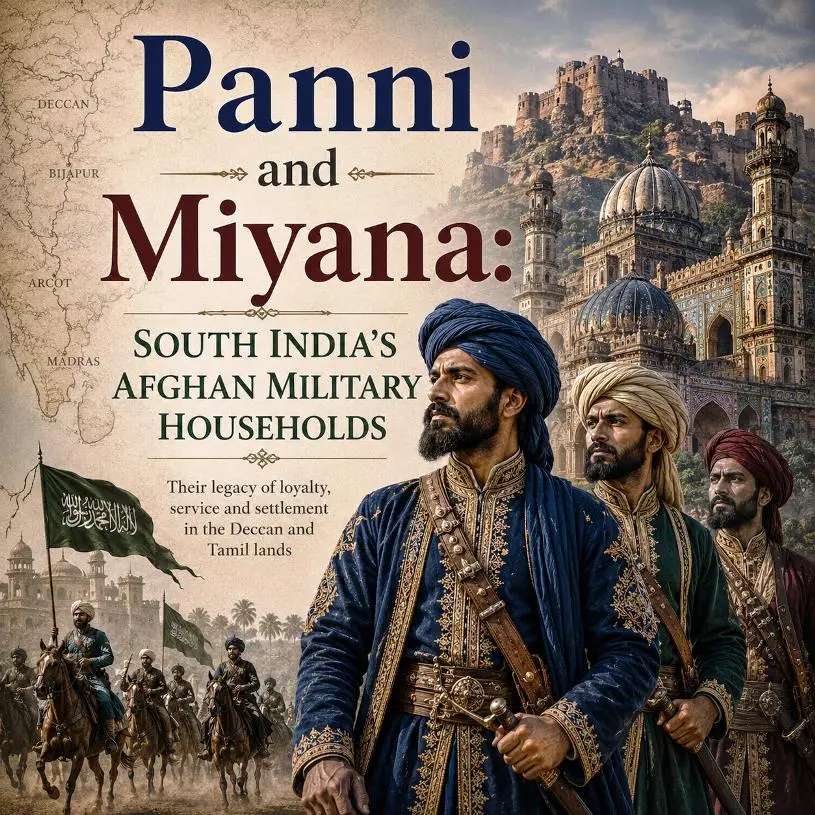
Long before the British East India Company set its sights on the Deccan, a smaller and far stranger story was already unfolding across the dry uplands between the Krishna and Kaveri rivers. Two Afghan families, the Pannis and the Miyanas, arrived in South India as exiles from a failed northern rebellion and went on to build military households that outlasted the Sultanates, survived the Mughal conquest, and ruled inland strongholds at Kadapa, Karnul, Savanur, and Bankapur for close to two centuries.
This period of Nayak, Deccan Sultanate, and early Mughal history rarely gets the attention it deserves, and the richest recent account of it sits inside a University of California Berkeley doctoral dissertation by historian Hannah Lord Archambault, drawn from Persian chronicles, Mughal administrative archives, and regional family histories most readers will never encounter. Her research paints a picture of Afghan soldiers of fortune who governed not through royal bloodlines but through household loyalty, marriage alliances, and a genius for reading whichever power happened to be ascendant at the moment.
What follows draws heavily on that dissertation research, along with published scholarship on the Deccan and the Nayak-era Karnatak, to trace a story most general histories of South India skip entirely. No encyclopedia entry captures the widow who held off an imperial army in her husband’s name, the Lingayat headman adopted into an Afghan household over a dispute about lamp oil, or the young queen of Tiruchirappalli whose betrayal became local legend. These are the kinds of details that only surface once a historian spends years inside archives in Hyderabad, Chennai, and Delhi, piecing together fragments most readers will otherwise never see.
A Failed Rebellion Sends Bahlul Khan Miyana South
The story begins in 1630, in the years following the accession of the Mughal emperor Shah Jahan. An Afghan nobleman named Khan Jahan Lodi rebelled against Mughal service and fled south into the Deccan with an entourage of loyal sardars, hoping to revive an Afghan kingdom around the old Nizam Shahi capital of Daulatabad. Among his companions rode Bahlul Khan Miyana, a man whose descendants would go on to dominate large stretches of the southern frontier for the next hundred and fifty years.
Lodi’s nerve failed him before his ambition did. Gathered with his supporters one evening, he worried aloud that a failed rebellion would bring Mughal retribution down on every Afghan family in India, not only his own. Bahlul Khan, disgusted by his patron’s hesitation, rose to walk away, delivering a rebuke that survives in the Persian chronicle Dhakhirat al-khawanin.
We joined you hoping for high rank under your kingship, and now you have thrown away your shield. What have we done to deserve dying alongside you?
Lodi stayed behind and was hunted down by Mughal forces, captured and executed on 24 January 1631, an event later commemorated in a Mughal court painting showing him mid execution with a strikingly resigned expression. Bahlul Khan, meanwhile, crossed south into the Bijapur Sultanate’s territory, choosing the unknown Karnatak frontier over certain death beside his former friend. That single decision to keep moving south set the entire Panni and Miyana story in motion.
The Karnatak Frontier: Where Cotton, Horses, and Politics Collided
The Karnatak, in the sense this dissertation uses the word, describes a much larger territory than the modern state of Karnataka. Deccan Sultanate writers, Mughal administrators, and later British officials all understood the term to cover the whole inland southern peninsula, bounded by the Eastern and Western Ghats and split into a highland zone above the mountains and a coastal lowland zone below them. Separating this southern world from the Deccan proper was the Raichur doab, a contested strip of land between the Krishna and Tungabhadra rivers that had divided the Vijayanagara Empire from the northern Sultanates for two centuries.
Cavalry warfare drove much of the region’s political calendar. Historian Jos Gommans has described the long medieval movement of horse-based armies down the subcontinent’s arid spine as one of the defining processes of the second millennium in South Asia, and the Karnatak sat at its southern terminus. At the same time, the region ran on cotton, textiles, and Indian Ocean trade passing through Coromandel port towns fed by the Penner, Palar, Ponniyar, and Kaveri rivers. Military households that wanted to survive here needed a foothold in both worlds: cavalry strength inland, and financial ties to the coast.
By the turn of the eighteenth century, the Panni and Miyana households had carved out exactly this dual position. The Pannis based themselves in Karnul, the Miyanas a short distance south in Kadapa, and a separate Miyana branch ruled the twin towns of Savanur and Bankapur further west. None of these places were major cities. British gazetteers from the nineteenth century described all three as scrappy, hot, and forgettable. Yet during the seventeenth and eighteenth centuries, these obscure towns sat at the center of South Indian politics, functioning as what historians Richard Eaton and Phillip Wagoner call secondary centers, hinge locations along trade routes whose control shaped the fortunes of far grander capitals like Bijapur, Golkonda, and Hyderabad.
Ruling Without a Crown: How Afghan Households Governed the South
One of the more surprising arguments running through this research concerns exactly who held power in the Karnatak. Rather than kings or sultans, Archambault argues the household itself functioned as the primary unit of politics. A household in this sense meant far more than a nuclear family. It included blood relatives, wives, dependents, retained soldiers, and any noble who had personally pledged loyalty to its leader, forming a mobile political and military organization capable of switching allegiance between Bijapur, the Mughals, or independent rule whenever circumstances demanded.
This flexibility explains how families like the Pannis and Miyanas survived the collapse of the same Sultanate and Mughal regimes they had once served. When Bijapur weakened, they joined the Mughals. When Mughal authority fractured after Aurangzeb’s death in 1707, they governed their strongholds as semi-independent rulers while still keeping up the paperwork of imperial service, since formal Mughal recognition still carried useful weight even after the emperor in Delhi had lost any real power to enforce his own orders.
Daud Khan Panni: The General Whose Widow Defied an Empire
Few figures in this story cut a more colorful path than Daud Khan Panni, a Mughal commander who spent close to two decades building power across the Deccan and Karnatak before his death in battle in 1715. Daud Khan served as the trusted deputy of the powerful Mughal noble Zulfiqar Khan, expanding Panni family holdings around Bir, Ambad, Amba Jogai, and Bhalavani while his brothers and cousins governed additional territories stretching as far as Burhanpur.
Daud Khan’s real skill lay in building what Archambault describes as an empire of influence rather than an empire of territory. He maintained a scattered network of jamadars, the mid-level recruiting captains who supplied horses and soldiers across the northern Deccan, tying together distant garrison towns through personal loyalty rather than direct administrative control. This network let him fund his southern campaigns in the Karnatak using resources drawn from jagirs held far to the north, an arrangement that worked beautifully so long as Daud Khan himself remained alive to hold the whole structure together through personal relationships built over decades of service.
The most striking episode from his career, though, belongs to his widow rather than to Daud Khan himself. Persian chronicler Khush Hal Chand recorded that the couple lived largely estranged, after Daud Khan reportedly spent his wedding night with a courtesan and his bride refused to forgive the insult, choosing a life of religious discipline instead of reconciliation. Yet when her husband died fighting the Mughal grandee Hussain Ali Khan, this same widow held the family’s estate at Zafarnagar in her own name and refused to surrender it quietly.
Hussain Ali Khan, flush with victory and eager to absorb Panni territory, sent an army against her. Khush Hal Chand’s chronicle describes her raising nearly twenty thousand fighters, Afghan and otherwise, and repelling three separate assaults before her husband’s killer finally gave up and withdrew from the region altogether. Chroniclers of the time reached for a memorable metaphor to describe the reversal, turning what Hussain Ali Khan expected to be an easy sweet treat into a dessert full of stones that cracked his teeth instead. A widow, estranged from her husband in life, ended up defending his legacy in death with more resolve than most of his male heirs managed to muster.
Kadapa and Karnul: Twin Capitals of the Afghan Deccan
Kadapa and Karnul, still commonly known by their colonial spellings Cuddapah and Kurnool, sat close enough to the Eastern Ghats to control mountain passes linking the coastal lowlands with the dry interior. Both towns straddled the divide between fertile black cotton soil and poorer red soil, and both fell within reach of two separate monsoon systems, the southwestern summer rains familiar across most of India and the retreating northeastern monsoon that soaks the Coromandel Coast each winter. Military campaigns, tribute collection, and trade caravans all moved to the rhythm of these two rainy seasons.
Local legend surrounding new settlements across the Karnatak often followed a familiar pattern, in which a hunter stumbles across a hare or fox that turns and attacks his hunting dogs instead of fleeing, a sign read as proof the ground itself carried a fierce, battle ready spirit worth building a city upon. Versions of this same origin story appear across Mackenzie Collection manuscripts describing towns throughout the region, Vijayanagara included, showing how deeply the households’ own foundation stories borrowed from a shared regional vocabulary of soldiering and destiny.
The Miyanas of Savanur, the Khan Gauras, and a Deal Sealed Over Lamp Oil
Far to the west, a separate branch of the Miyana family ruled Savanur and Bankapur, where their most enduring alliance grew out of an almost domestic incident. According to the Persian chronicle known as the Tazkira, a Sultanate nobleman named Ankas Khan, remembered as an early Miyana forebear, ran short of lamp oil one evening during a late night game of chess. A nearby Lingayat village headman named Somanna heard about the shortage and sent over several casks of his household’s own oil without being asked.
Ankas Khan responded to the gesture with startling generosity of his own, calling Somanna into open court, placing a hand on his head, and declaring the headman his adopted son under his protection for life. Somanna received the hereditary title of revenue collector for Lakshmeshwar, a share of local tax income, land, and the honorific Khan Gaura Bahadur. Generations later, this bond still held real political weight. When a Miyana leader named Ghafar Khan tried to strip away the Khan Gauras’ privileges in the 1720s, dismissing the family as mere servants of idols, Somanna’s descendant Chik Khan Gaura sent back a proud and pointed reply.
Though I follow the Hindu community, I remain obedient to Islam, and murdering loyal tribute paying subjects does not suit a descendant of a holy lineage.
Ghafar Khan attacked anyway, but the episode captures something essential about how these Afghan households functioned day to day, in practice rather than on paper. Religious and ethnic labels mattered far less on the ground than personal bonds of patronage, protection, and reciprocal obligation built up across generations.
Cousins at War: The Myth of Afghan Solidarity
A popular assumption holds that shared Afghan ancestry, referred to in Persian sources as qaum, bound these soldiering communities together in some deep tribal loyalty overriding all other concerns. Archambault’s research picks this idea apart using a battle from the mid-1670s between Bijapur Sultanate and Mughal forces at the fortress of Naldurg. On the Bijapuri side commanded Abdul Karim Khan Miyana. On the Mughal side stood his own first cousin, Ikhlas Khan Miyana. Trapped inside the fortress itself were the sons of a deceased Panni commander, whose loyalties belonged to neither camp cleanly.
Abdul Karim Khan eventually captured the fort and, according to the Mughal chronicler Bhimsen Saxsena, dealt brutally with many defenders inside, yet spared the Panni brothers, the sons of his own family’s former retainer. Shortly afterward those same Panni brothers negotiated their own surrender directly to the Mughals in exchange for rank and salary, brokered through their uncle, a long serving Mughal officer. Cousins fought cousins, former allies switched sides mid-conflict, and questions of shared Afghan identity did little to predict who ended up loyal to whom. Personal patronage, family debts, and cold calculation shaped outcomes far more reliably than any notion of ethnic brotherhood.
The Nawaiyats of Arcot and the Road Toward the Carnatic Wars
As the eighteenth century progressed, a rival power center rose at Arcot under the Nawaiyat family, a Konkan Muslim merchant lineage rather than an Afghan one, though closely entangled with Panni and Miyana affairs throughout the period. Arcot itself began as a temporary Mughal army camp before growing into a permanent seat of government for the newly created Karnatak Nizamat.
Struggles over succession to this same Arcot governorship would eventually draw in French and British trading interests along the Coromandel Coast, setting the stage for the Carnatic Wars later in the century, conflicts that pulled European companies directly into South Indian succession politics for the first time.
Battle of Shakar Khera: A Fateful Bet on the Wrong Side
Long before the events of 1748, the Karnatak households had already gambled once on the losing side of a Deccan power struggle, and the memory of that defeat shaped decisions for the following generation. In 1724, a contest broke out between Nizam al-Mulk, founder of what would become Hyderabad state, and a rival Mughal appointee named Mubariz Khan over control of the Deccan governorship. The reigning emperor in Delhi had formally confirmed Mubariz Khan’s authority and written directly to the Karnatak’s Afghan and Nawaiyat commanders instructing them to support him.
Loyal to their imperial paperwork, the households answered the call in force. Abdul Nabi Khan Miyana of Kadapa sent his son north with troops, Ibrahim Khan Panni of Karnul led his own contingent personally, and additional commanders marched up from Bankapur and Arcot to join the coalition. Waiting for them at the battlefield of Shakar Khera stood Nizam al-Mulk’s own alliance, built around a Maratha contingent under Baji Rao Vishwanath and a network of northern Deccan military captains the Nizam had spent years quietly cultivating with loans and patronage during an earlier stint governing Malwa.
Nizam al-Mulk won decisively. The households that had backed Mubariz Khan found themselves suddenly out of favor with the Deccan’s new strongman right as the Panni family’s own once formidable recruitment network, built up over decades by the late Daud Khan Panni, was unraveling into competing claims fought over by rival Mughal grandees and Maratha commanders. Shakar Khera cost the Karnatak households more than a single battlefield defeat. The loss cost them their privileged position with whichever power now controlled the northern Deccan, a setback that would matter enormously two decades later when the stakes rose even higher.
The Fall of Queen Minakshi of Tiruchirappalli
Not every dramatic turn in this story involves the Pannis or Miyanas directly. Some of the most striking episodes belong to their close associates, the Nawaiyats, whose fortunes rose and fell alongside the Afghan households throughout this same period. One especially vivid account, preserved in the Persian chronicle Tuzuk-i Wala Jahi, concerns Chanda Sahib, son-in-law of the Arcot ruler Safdar Ali Khan, and his seizure of the fortress city of Tiruchirappalli in the early 1730s.
Following the death of her husband in 1732, a young queen named Minakshi found herself ruling Tiruchirappalli alone. trichinopoly-1752/" class="sial-auto-link">Chanda Sahib, recognizing an opportunity, worked his way into her confidence, reportedly swearing an oath of protection over the Quran itself to win her trust. Once inside the city walls under this pretense of friendship, he turned on his host and seized the fortress by force.
Minakshi, seeing both her own betrayal and the end of her rule laid bare, is said to have chosen to end her life on a funeral pyre, clutching a copy of the Quran to her chest as the flames rose around her. The chronicler recorded that while the rest of her body burned, the book and the area near her heart remained untouched by the fire, a detail read at the time as proof of the queen’s virtue and a warning of the reckoning awaiting the faithless liar who had wronged her.
Chanda Sahib did not enjoy his prize for long. A Maratha army under Raghuji Bhonsle swept south soon afterward, besieging Tiruchirappalli and killing Chanda Sahib’s own brothers as they rushed to defend him. Local fighters skilled at scaling fortress walls, drawn from Poligar and Kallar communities allied with the Maratha campaign, finally forced Chanda Sahib’s surrender.
The Marathas carried him north as a prisoner, plundering Karnul, Kadapa, and surrounding Panni and Miyana territory along the return march so thoroughly that oral memory of the destruction survived in the region for well over a century afterward, remembered locally as the year the Afghan defenders, styled in local accounts as the brave Patans, were forced into panicked flight before the invading force.
1748 to 1751: The Succession War That Broke the Karnatak Households
The turning point for the entire household system arrived between 1748 and 1751. Following the death of the Hyderabad state’s founder, Nizam al-Mulk Asaf Jah, rival claimants to the Hyderabadi throne went looking for allies across the strategically vital southern Karnatak. Their rivalry quickly tangled together with a parallel contest between French and British East India Company forces competing for dominance along the coast.
Sensing an opening, the Miyana and Panni households made a bold and ultimately reckless bid to force their way into these high stakes negotiations from the margins where they had been sitting for years. The gamble failed disastrously. French forces and the victorious Hyderabadi faction turned on the households with real force, leaving behind a political vacuum across the Karnatak that neither family would ever fill again. Only one senior household leader, Abdul Nabi Khan, known widely as Mocha Miyan, survived the crushing defeat, fleeing badly wounded back toward Kadapa, only to be pushed aside almost immediately by his own nephew Abdul Majid Khan amid disputes over unpaid soldiers’ wages.
The White Serpent and the End of Household Rule in Kadapa
Abdul Majid Khan’s response to this crisis earned him a nickname that stuck to both friends and enemies alike: mar-i safid, the White Serpent, a reputation built on his relentless, break-with-precedent tribute campaigns against neighbors who had once been trusted allies. His aggressive rebuilding effort bought Kadapa a little more time, but continuous Maratha and Mysore raids, combined with internal household rivalries, finally proved unstoppable. In 1777, the Miyana household lost its claim over Kadapa for good.
The chief beneficiary of this long collapse was the Mysore Sultanate, which rose with striking speed to dominate much of the inland Karnatak by the century’s end. Interestingly, one popular genealogy claimed Mysore’s founder Hyder Ali Khan descended from a Bijapuri prince secretly sheltered for generations under Miyana protection in Kadapa itself, receiving the honorific title of Nayak from his Afghan patrons long before fortune carried his branch of the family north to Mysore. True or invented, the story reveals how thoroughly the memory of Afghan household rule had woven itself into the origin stories of the very states that eventually replaced it.
How the Kurnool Nawabate Actually Ended: Ghulam Rasool Khan’s Last Stand
The Panni line that Daud Khan Panni helped build did not vanish quietly after the household system collapsed in the 1750s. Kurnool survived as a smaller princely state under a run of later Panni Nawabs, passing through the hands of rulers named Ibrahim Khan, Alaf Khan, Himayat Bahadur Khan, and Ranmust Khan across the second half of the eighteenth century, before falling under the loose overlordship of the Nizam of Hyderabad. Its final chapter belongs to Ghulam Rasool Khan, who took the throne in 1823 and spent the next sixteen years openly preparing for a fight the British East India Company had no intention of allowing him to win.
Ghulam Rasool Khan distrusted the Company from the start of his rule. He turned Kurnool fort into a working ordnance factory, stockpiling weapons, and cultivated an alliance with Mubariz-ud-Daulah, a prince connected to the Hyderabad court who shared his suspicion of British expansion. That partnership eventually cost him dearly. Jealous relatives inside his own family, eager to seize the throne for themselves, tipped off the British Resident General Fraser about the Nawab’s military buildup in August 1839. Fraser sent an officer named Edward Armstrong to confirm the reports, and once Armstrong’s findings reached Company headquarters, an armed response followed within weeks.
Colonel A.B. Dyce led Company troops to surround Kurnool fort in October 1839. The siege dragged on for six days before Ghulam Rasool Khan was finally run down and captured at a village called Joharapuram near the city. The British transported him south to Tiruchirappalli and held him in the jail there, far from any support base among his own people. He never regained his freedom.
According to research published by writer Syed Naseer Ahamad, who has spent decades documenting Muslim contributions to India’s freedom struggle, the British arranged to have the Nawab’s own servant slip poison into his food, and Ghulam Rasool Khan died in custody on 12 July 1840. The servant accused of the killing was later tried and sentenced to death, a detail that did little to change the outcome for the Nawab whose kingdom had just been absorbed into Company territory.
Local memory in the Rayalaseema region has held onto this story longer than most formal history books have. A folk ballad known as Kandanavolu Nawabu Katha, the Story of the Kurnool Nawab, is still sung in villages across the district, keeping alive the memory of a ruler who chose armed resistance over quiet submission to the Company nearly two centuries ago. Where Daud Khan Panni’s widow had once held off an imperial army with defiance and troops of her own, Ghulam Rasool Khan’s end came instead through betrayal from within his own family, a reminder that the household loyalty which had built Panni power in the first place could just as easily unravel it from the inside.
What the Afghan Soldiers of Fortune Left Behind
By the closing decades of the eighteenth century, the Panni and Miyana households had shrunk into the small, dependent principalities history mostly remembers them as today, ruling at the pleasure of Hyderabad, the Marathas, Mysore, and eventually the British East India Company. Yet for nearly two hundred years before that decline, these Afghan military households functioned as one of the primary organizing forces of South Indian politics, moving fluently between Sultanate, Mughal, and independent rule while building genuine, lasting alliances with Hindu village leaders, Lingayat headmen, and local soldiering communities across the Deccan and Karnatak.
Their story complicates a familiar narrative that treats Afghan soldiers in India as foreign outsiders defined chiefly by religion and geography. The households that ruled Kadapa, Karnul, Savanur, and Bankapur built their success on deep local knowledge, patient alliance building, and a talent for reading political winds rather than on any imported northern identity. Reading their history today offers a far richer picture of Nayak period and early modern South India than most popular accounts allow, one built from soldiers, widows, village headmen, and cousins on opposite sides of the same battlefield, all navigating a southern frontier where household loyalty counted for more than any throne.
None of this history survives in stone monuments the way Vijayanagara’s ruins or the great Nayak temple complexes do. The Panni and Miyana story lives instead in scattered Persian manuscripts, faded Mughal muster rolls, and family memory passed down in towns most travel guides skip entirely. That scarcity of physical remains may explain why popular history has largely forgotten a chapter that shaped the political map of the Deccan and the Karnatak for close to two hundred years. Kadapa and Karnul today are known mainly for their modern industry and politics, with little public memory of the Afghan generals, widows, and jamadars who once made these small towns matter to emperors and European trading companies alike.
Bibliography
- Ahamad, Syed Naseer. “Ghulam Rasool Khan: Nawab of Kurnool and a Great Freedom Fighter.” Heritage Times. https://www.heritagetimes.in/nawab-of-kurnool
- Archambault, Hannah Lord. “Geographies of Influence: Two Afghan Military Households in 17th and 18th Century South India.” PhD dissertation, University of California, Berkeley, 2018. https://escholarship.org/uc/item/17c0k41d
- Eaton, Richard M. A Social History of the Deccan, 1300-1761: Eight Indian Lives. Cambridge: Cambridge University Press, 2005.
- Faruqui, Munis D. The Princes of the Mughal Empire, 1504-1719. Cambridge: Cambridge University Press, 2012.
Related Posts
- The Forgotten Afghan Kingdoms of South India
- The Battle of Talikota: Fall of the Vijayanagara Empire
- Fourth Mysore War (1799): Fall of Tipu Sultan and the End of Mysore Resistance
- Tipu Sultan and the Third Anglo-Mysore War: Complete History
- Haidar Ali and the Second Anglo-Mysore War: Complete History
- The First Anglo-Mysore War: Battles, Strategy and British Defeat
- French Settlements in Tamil Nadu: The Full History of Pondicherry

Post Comment