The Armenians of Madras: Merchants Who Wrote Themselves Into Tamil Nadu’s History
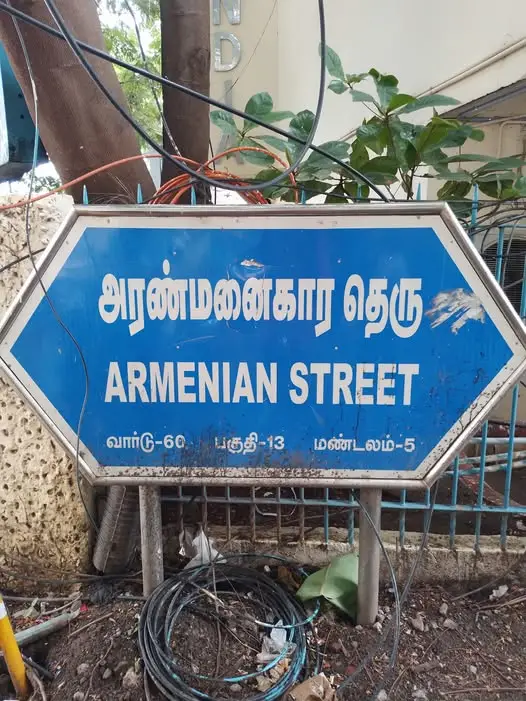
In the crowded lanes of George Town, wedged between Parry’s Corner and the Madras High Court, a narrow street still carries a name that has puzzled generations of Tamil-speaking Chennaiites: Armenian Street, locally corrupted over the centuries into “Aranmanaikaran Street” — the street of the palace people, even though no palace ever stood there. The confusion is fitting, in a way. Few residents of the street today know that it commemorates a community that, for the better part of three hundred years, was among the wealthiest, most connected, and most politically consequential trading groups in colonial Madras — a community that built the city’s oldest surviving church, financed its first bridge, signed treaties with the East India Company on behalf of an entire “Armenian Nation,” and printed both the world’s first Armenian newspaper and the first Armenian republican constitution, all from a small merchant quarter beside the Bay of Bengal.
This is the story of the Armenians of Madras: where they came from, how they built one of the diaspora’s most remarkable outposts, and why, today, almost none of them remain.
A People Without Borders: The Origins of the Armenian Trade Diaspora
To understand why Armenian merchants ended up in Tamil Nadu at all, it helps to understand what kind of people they were by the time they arrived. The Armenians are an ancient people of the Armenian highlands, straddling the frontier of Europe and Asia, with their own script developed in the 5th century CE and their own church — the Armenian Apostolic Church, independent of Rome — regarded as the world’s oldest national church. For much of the medieval and early modern period, Armenia the political entity simply did not exist; from roughly the 11th century until the 20th, the Armenian homeland was carved up and ruled in turn by Ottomans, Persians, and Russians. Yet the Armenian people persisted as a “trade diaspora” — a network of merchant communities scattered from Amsterdam to Manila, bound together not by a state but by shared language, faith, and kinship.
That diaspora took its modern shape through a specific historical trauma. According to the historian Sebouh Aslanian, whose research underpins much of what is known about Armenian trade networks, the collapse of the last Armenian kingdom in the 11th century triggered waves of migration toward Crimea, and from there into Poland and onward across Europe. When the Ottomans captured Crimea in the late 15th century, more Armenians scattered into Eastern and Central Europe, while others settled in a cluster of towns along the frontier between the Ottoman and Safavid empires — the most prominent of them, Old Julfa. It was here that Armenian merchants built their reputation as brokers between the silk-producing regions of Persia and buyers in Europe.
In 1604–05, the Safavid ruler Shah Abbas I, retreating before an Ottoman advance and pursuing a scorched-earth policy, forcibly uprooted the entire population of Old Julfa and resettled them near his new capital at Isfahan. There, the displaced merchants rebuilt their fortunes and founded New Julfa — and from this single relocated community, Armenian trading houses spread a commercial network stretching, remarkably, from Amsterdam in the west to Manila in the east. It was New Julfan merchants, or families connected to them, who would eventually make their way to the Coromandel Coast and to Madras.
Armenians in India Before Madras
Armenian traders had a foothold in the Indian subcontinent well before New Julfa existed, and well before Madras was founded. The earliest documented references come from Portuguese sources of the early 16th century, which describe Armenian merchants based in Pulicat — then part of the Vijayanagara kingdom — guiding Portuguese traders to a church at Mylapore holding the tomb of St. Thomas the Apostle, who Christian tradition holds preached and died on India’s east coast. Some later accounts even credit Armenians with constructing the first religious structure on St. Thomas’s hill in Madras as early as 1547, decades before any European power controlled the site.
Further north, the Mughal emperor Akbar actively invited Armenian merchants to settle in his capital, Agra, where the first Armenian church in India was consecrated in 1562. Armenians occupied genuinely prominent positions at the Mughal court — one Armenian, Mirza Zu’l-Qarnayn, was even appointed governor of Bengal. As New Julfa grew into a major commercial hub after 1605, its merchant network fanned out rapidly across the subcontinent, with Armenian trading houses established in Hooghly, Patna, Calcutta, Golconda, and Masulipatnam. Armenians are believed to have been trading in and around what would become Calcutta roughly fifty years before the English East India Company opened its first factory there in 1690.
The English quickly recognised how valuable this network was. Armenian merchants, fluent in Persian and already embedded across Mughal territory, made ideal trading partners and interpreters. In 1665, the President of the East India Company personally invited Armenians to settle in Bombay; by 1673, the Company’s Court of Directors was instructing its own agents in Persia to lodge with Armenian merchants specifically in order to learn their language and study their business methods.
Individual Armenians such as Khwaja Sarhad went on to play outsized diplomatic roles — Sarhad’s negotiations with the Mughal court helped secure the 1717 farman from Emperor Farrukh Siyar that granted the East India Company duty-free trading rights in Bengal, a concession that would prove foundational to Britain’s commercial expansion in India.
The 1688 Treaty: An “Armenian Nation” Negotiates With the Company
The most consequential early encounter between Armenians and the English East India Company, however, happened not in India but in London, and it set the terms for everything that followed in Madras. In 1688, the Company’s Court of Directors approached Khoja Panos Kalantar (also rendered Panos Calendar), a prominent New Julfan merchant then based in London, with a proposal: abandon the long, dangerous overland trade route through Ottoman territory between Mughal India and Europe, and instead ship Armenian goods on English vessels.

In exchange, the Company made extraordinary promises. Armenians would have the liberty to live in any of the Company’s settlements in India, to buy and sell land and property, to hold civil office “in the same manner as if they were Englishmen born,” and to practise their religion without interference. Two supplementary agreements sweetened the deal further: one granted Panos Kalantar and his family a personal monopoly on the garnet trade at a favourable customs rate in London, and the other committed the Company to fund the construction of a church, with an annual priest’s allowance, in any of its settlements where the Armenian population exceeded forty people.
What makes this treaty historically remarkable is not just its content but its framing. Panos Kalantar did not sign as an individual merchant or even as a representative of New Julfa — he signed explicitly on behalf of “the Armenian Nation,” at a time when no sovereign Armenian state existed anywhere on earth. It reflects a self-understanding that Armenian merchant communities, wherever they were scattered, considered themselves bound together as a single people entitled to negotiate collectively — a sentiment that would resurface, more explicitly still, a century later on the streets of Madras.
Madras: “John Company’s Madraspatnam” and the First Settlers
The English East India Company founded Fort St. George and the settlement of Madras in 1639, a modest fortified trading post on the Coromandel Coast. Armenian merchants were drawn to the new settlement almost immediately, alongside Jewish traders — together, historical tradition credits Armenians and Jews as the founders of the first mercantile house in the city, known as “John Company’s Madraspatnam.” Julfan-connected merchants had established themselves in Madras by at least 1666, and the city’s oldest identified cemetery is an Armenian burial ground dating to 1663, associated with a merchant named Khojah Davit.
The first Armenian settler in Madras “to be identified with a history,” in the words of Chennai historian S. Muthiah, was Coja Nazar Jacob Jan, who lived in the city from 1702 until his death in 1740. His fortune — accumulated through trade stretching across the Bay of Bengal to Manila and westward toward the Persian Gulf — passed on his death to his brother-in-law, Coja Sultan David, setting off a chain of events that would eventually produce Madras’s most consequential Armenian resident.
True to the terms of the 1688 treaty, the growing Armenian population of Madras prompted the Company to sponsor a wooden church for the community; by 1712 this had been rebuilt into a more permanent structure — the Armenian Church that still stands on Armenian Street today, and around which the surrounding neighbourhood took its name.
A Family Tragedy and the Rise of Shahamir Shahamirian
The story of Coja Sultan David’s inheritance carries an unusually personal, almost novelistic, weight for a chapter of trade history. After inheriting Coja Nazar’s fortune, Sultan David sent his wife Anem and young son Shahmir to New Julfa to formally claim the property.
The mayor of New Julfa seized the pair and had them brutally beaten until they renounced the inheritance. Justice was eventually secured, but by the time mother and son could make their way back toward Madras, catastrophe struck the family again: when the French captured Madras between 1746 and 1749, Sultan David was forcibly deported to Pondicherry, where he died in 1754. His wife, unaware of his fate, wrote him a letter in 1747 with a lock of her own hair enclosed — a letter that never reached him, seized by the English along with the ship carrying it during hostilities with the French.
Out of this upheaval, Sultan David’s son — Shahmir Shahamirian — emerged as the wealthiest and most influential Armenian in eighteenth-century Madras, his fortune built on trade across entrepôts stretching from Manila to the Persian Gulf. But Shahamirian’s significance to Armenian history goes well beyond commerce. Born in New Julfa in 1723 and settled in Madras by the 1740s, he became the central figure of a genuine Armenian nationalist movement operating from within a British colonial city. His son, Aga Hakob Shahamirian, established the first Armenian printing press in India in Madras in 1771–72, and together with his father and the writer Movses Baghramian, the family produced the Nor Tetrak Koči Yordorak (“A New Book Called Exhortation”), a political tract that mourned the loss of Armenian statehood and called for armed uprising against Ottoman and Persian rule.
Then, in 1787–88, Shahamirian went further still, authoring Vorogayt Parats — “Snare of Glory” — a detailed proposed republican constitution for a future independent Armenian state, published under his son’s name. It stands today as the earliest known Armenian constitutional text, drafted more than a hundred years before any Armenian republic actually existed, written not in the Caucasus but in a merchant’s house near Armenian Street in colonial Madras. Shahamirian’s patriotism showed in smaller gestures too — surviving Chinese porcelain teacups in a European museum collection are believed to have been commissioned by him, part of a set expressing Armenian national sentiment through decorative art.
Shahamirian’s wealth also rebuilt the physical heart of the Madras community. When the French razed the original Armenian Church during their occupation of the city, it was Shahamirian who donated the ancestral land on which the church was reconstructed in 1772 — the same building that stands today. Inside, a chamber known as “Shamier’s Room” commemorates his wife, who died in 1765, and two of the church’s six bells were donated in 1790 by his relative Aga Shawmier Soothanoomian in memory of a son who died at nineteen. Shahamir Shahamirian himself died in 1797 and is buried beside his wife within the church grounds he helped rebuild.
Coja Petrus Uscan: Loyalty, Wealth, and the Marmalong Bridge
If Shahamirian represents the Armenian community’s intellectual and political ambitions, Coja Petrus Uscan represents its civic footprint on the physical city. Born in New Julfa around 1680–81, Uscan settled in Madras in 1723 and remained there until his death in 1751, building his fortune on a family trade monopoly running between India and Spanish-controlled Manila. Unlike most of his fellow Armenian merchants, who belonged to the Armenian Apostolic Church, Uscan was a Roman Catholic — a detail that shaped both his religious patronage and his social position within Madras’s small Christian community.
Uscan’s loyalty to the British became legendary in local memory. When the French captured Madras in 1746, they seized virtually all of Uscan’s wealth and carried it off to Pondicherry, while Uscan himself fled to the Dutch settlement of Tranquebar. The French governor Dupleix personally offered to restore his fortune if he would resettle under French protection in Pondicherry. Uscan refused, reportedly explaining that Armenian tradition demanded loyalty to one’s benefactors — in his case, the British, under whose territory he had built his wealth. When Madras was restored to British control in 1749, this loyalty was rewarded: Uscan was the only Armenian merchant permitted to continue residing within the walls of Fort St. George itself.
His philanthropy left a lasting mark on the city’s geography. In 1726, Uscan financed the construction of the first bridge across the Adyar River near Saidapet — the Marmalong Bridge, which survives today, much altered, as the Maraimalai Adigal Bridge — specifically to ease pilgrim access to St. Thomas Mount, the hill where the apostle is believed to have been martyred. He went further, funding roughly 160 stone steps leading up to the shrine atop the mount, and in 1729 contributed generously to the building of St. Rita’s Church, where a plaque still describes itself as built “in memory of the Armenian Nation.” At his death, despite the losses inflicted by the French occupation, Uscan left behind an enormous fortune — seven lakh rupees in cash alone — to his widow, who continued his charitable work. In accordance with Armenian custom, his heart was carried back to New Julfa in a golden box and interred in the courtyard of the All Saviour’s Cathedral, even as his body remained buried in the city he had chosen over his own wealth.
Rev. Harutiun Shmavonian and the World’s First Armenian Newspaper
The most globally significant contribution of the Madras Armenian community, though, may be a newspaper. Its origin story begins with personal grief: Reverend Harutiun Shmavonian, born in Shiraz, Iran, in 1750, lost both of his young sons within the span of a single week. Devastated, he withdrew for seven years into self-imposed exile among Persian holy men, during which he mastered Persian and Arabic. That period of study proved unexpectedly fortuitous — when the Armenian Church called him to serve as priest in Madras, a post he held from 1784 to 1824, his linguistic skill allowed him to establish the city’s second Armenian printing press in 1789, distinctive for printing works in Arabic and Persian as well as Armenian, with special permission granted by the Nawab of the Carnatic himself, who held Shmavonian’s scholarship in high regard.
In August 1794, Shmavonian announced his intention to launch a periodical, promising readers a monthly digest of significant events drawn from gazettes and books, alongside a calendar of religious festivals and lunar dates. On October 16, 1794, that publication — Azdarar, meaning “The Intelligencer” — became the world’s first Armenian-language newspaper, and notably also the first non-English newspaper published anywhere in India. Over the eighteen months of its existence, ending in March 1796, Shmavonian produced eighteen issues totalling 965 pages of cultural, historical, and commercial content for an Armenian merchant readership scattered across Madras and beyond.
Its influence rippled outward across the diaspora: Bombay produced its own Armenian periodical in 1815, Calcutta followed in 1820 and 1821, and Constantinople — the great historic centre of Armenian print culture — did not manage a periodical of its own until 1832, nearly four decades after Madras. In recognition of this legacy, the government of Armenia has, since 2004, marked October 16 each year as Armenian Press Day. Shmavonian’s grave lies today in the courtyard of St. Mary’s Armenian Church, marked with a stone carved with an open book bearing the single word “Azdarar.”
Trade, Wealth, and a Community of 200
At its height in the eighteenth century, the Armenian merchant community of Madras numbered somewhere between 200 and 240 individuals — a small population by any measure, but one that punched dramatically above its weight in wealth and influence. Most were of New Julfan origin, engaged principally in the export of gemstones, spices, silk, and fine fabrics, moving goods westward toward Europe and Persia and eastward toward Manila. Khojah Petros Voskan — very likely the same figure known elsewhere as Coja Petrus Uscan, given the interchangeable spellings common in colonial records — is remembered as the wealthiest resident of Madras of any community in the eighteenth century, a striking claim given how small the Armenian population actually was relative to the city’s Tamil, European, and other communities.
This prosperity rested on privileges the community had negotiated collectively, going back to the 1688 treaty, and on relationships cultivated carefully with successive rulers of the Carnatic. It also rested, less happily, on the community’s usefulness to the East India Company as it expanded its own commercial ambitions across the Coromandel Coast — a dependency that would eventually prove the seed of the community’s decline.
Decline: From a Thriving Quarter to a Handful of Families
The same East India Company that had once courted Armenian merchants with generous treaties gradually squeezed them out of relevance. Through the second half of the eighteenth century and into the nineteenth, the Company’s expanding monopoly over Indian trade steadily narrowed the commercial space in which independent Armenian merchant houses could operate. As Company control tightened, the economic incentives that had drawn generations of New Julfan families to Madras evaporated, and the flow of new Armenian arrivals slowed and then stopped almost entirely. Many established families relocated to Calcutta, where a larger and more durable Armenian community persisted — one that survives in smaller form even today, still observing Armenian Orthodox Christmas on January 6.
The catastrophe of the Armenian Genocide in the final years of the Ottoman Empire and the early twentieth century further reshaped the global diaspora, as survivors overwhelmingly sought refuge in Western countries rather than in India’s colonial port cities, which by then offered little in the way of the commercial opportunity that had originally drawn Armenians there. By the early twenty-first century, reports suggested fewer than five Armenians remained resident in Chennai, and around 2007 the city’s last Armenian resident is understood to have relocated to Bengaluru, closing out a continuous presence that had lasted well over three centuries.
What Survives Today
Physically, remarkably much survives, even if the people are gone. St. Mary’s Armenian Church still stands on Armenian Street, its distinctive six-bell belfry intact, its courtyard shaded by frangipani trees and holding the graves of some 350 Armenians who lived and died in the city, the last of them interred there in 1850. A Sunday service continues to be rung out on schedule, and an annual commemorative gathering — often attended by Armenian visitors and diaspora descendants from as far away as Kolkata, the Gulf, and Armenia itself — keeps a thin thread of ritual continuity alive even without a resident congregation. The church is maintained today through contributions from the worldwide Armenian community rather than local churchgoers.
Beyond the church, Chennai’s map still quietly records the community’s presence: Armenian Street itself, the smaller Shamirian Street named for Shahamir Shahamirian’s family, and Arathoon Road in Royapuram, whose name is believed to be a corruption of “Harathun” — a tribute, whether intentional or accidental, to Rev. Harutiun Shmavonian. The Marmalong Bridge that Coja Petrus Uscan financed still carries traffic across the Adyar, rebuilt and renamed the Maraimalai Adigal Bridge but tracing its origin directly to his 1726 endowment.
Diplomatically, the connection has been revived in recent decades. The 300th anniversary of the Armenian presence in Madras, marked around 2012, brought renewed attention from the Armenian Church hierarchy in Calcutta and from the Republic of Armenia itself, which has discussed commemorative monuments in Chennai to mark the countries’ modern diplomatic ties. Local heritage writers and historians continue to research and publish on the community — much of what is documented about figures like Shahamirian and Uscan has been recovered through painstaking archival work by scholars such as Sebouh Aslanian and Chennai’s own S. Muthiah, whose books remain the primary sources for reconstructing this history in detail.
A Nation That Lived, Briefly, on One Tamil Street
The story of the Armenians in Madras is, in miniature, the story of a stateless people’s entire diasporic experience: displacement from a homeland, the construction of prosperity and identity far from that homeland, an unusually fierce insistence on nationhood even in the total absence of a national territory, and, eventually, dispersal once more as the economic and political conditions that had sustained the community shifted beneath it.
What makes the Madras chapter extraordinary is not merely that it happened, but what it produced in barely a century and a half — a treaty negotiated on behalf of an entire “nation,” the first Armenian printing press in India, the first Armenian republican constitution ever drafted, and the first Armenian newspaper printed anywhere in the world, all originating from a single narrow street in a Tamil port city that most of its own Armenian architects would never see decline.
Today, Armenian Street carries fruit vendors, small traders, and commuters hurrying past the Madras High Court, largely indifferent to the name over their heads. But inside the gates of St. Mary’s Armenian Church, in the quiet of a courtyard planted with frangipani, the graves of Shahamirian, Shmavonian, and hundreds of others still keep watch over a chapter of Tamil Nadu’s history that connected this coastline, however briefly, to the Caucasus, New Julfa, and a national dream that would not become a reality until more than a century after the last Armenian left Madras.
Related Posts
- Fort Geldria to Fort Sadras: The Dutch in Tamil Nadu
- The Fall of Pondicherry: How the Third Carnatic War Ended French India
- French Settlements in Tamil Nadu: The Full History of Pondicherry
- Porto Novo : A 500-Year Journey Through Tamil Nadu’s Trading Past
- The Forgotten Afghan Kingdoms of South India
Post Comment