The Fall of Anuradhapura and Rise of Polonnaruwa : Rajaraja and Rajendra Chola’s Invasion of Sri Lanka
The Chola conquest of Anuradhapura stands as one of the most important turning points in the history of Sri Lanka and South India. For more than thirteen centuries the city of Anuradhapura had served as the political, religious, and cultural heart of the Sinhalese people. Then, in the final years of the tenth century and the early years of the eleventh century, powerful armies from the Chola Empire of the Tamil country crossed the Palk Strait, destroyed the ancient capital, and brought large parts of the island under foreign rule. The event ended the long Anuradhapura period and began a new era centred on the city of Polonnaruwa.
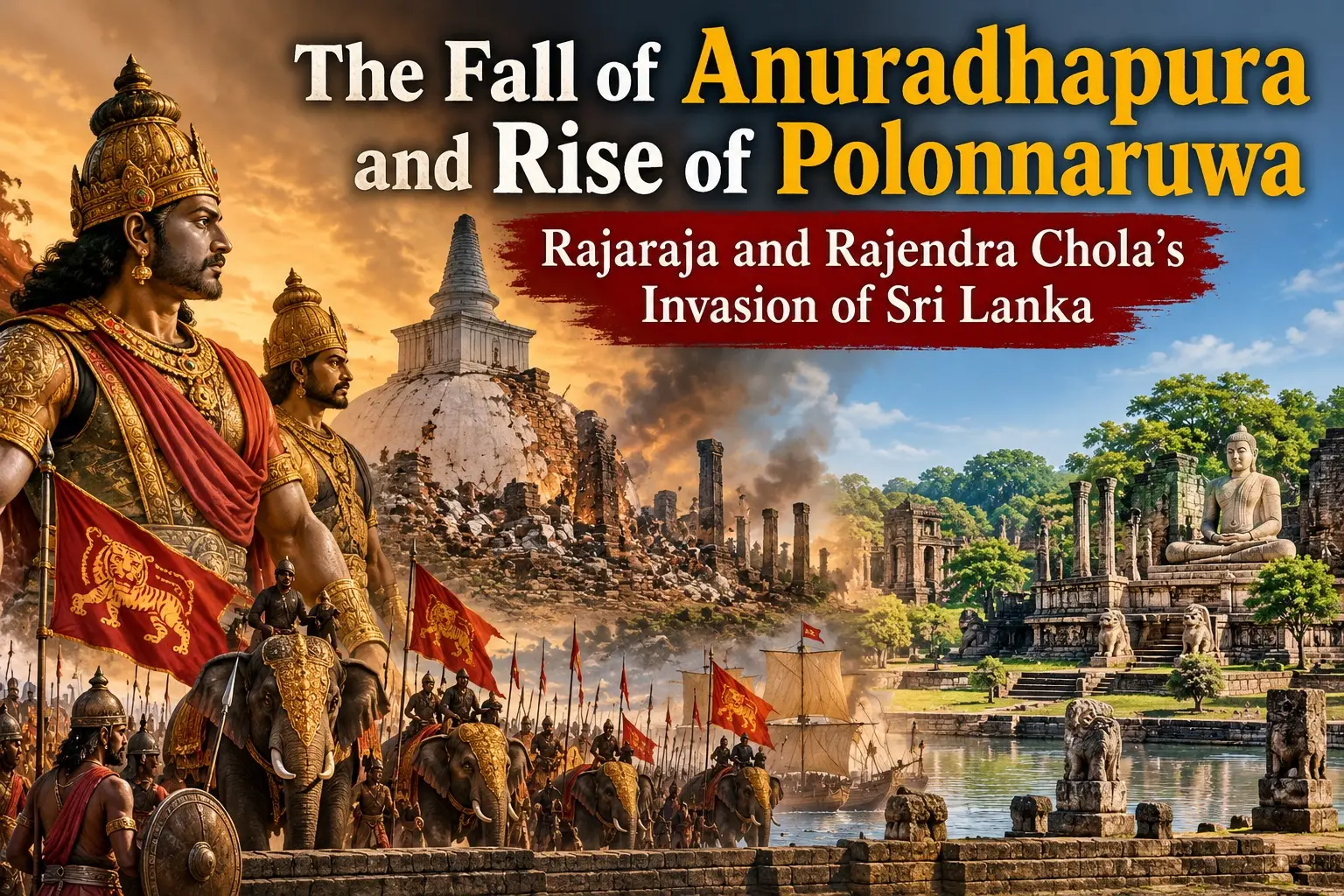
This article presents the full story in clear and straightforward language. It explains the background of both the Chola Empire and the Anuradhapura Kingdom, the reasons for the invasion, the two main military campaigns, the nature of Chola government on the island, the changes in religion and culture, the long years of resistance, the final liberation, and the lasting consequences. The account is based on Chola inscriptions carved on stone and copper plates, the Sinhalese chronicles known as the Mahavamsa and Culavamsa, and the work of modern historians and archaeologists.
The Chola Empire at Its Height
The Cholas were an old Tamil dynasty whose heartland lay in the rich Kaveri river delta in present-day Tamil Nadu. After periods of weakness they rose again in the ninth century. By the reign of Rajaraja Chola I, who ruled from 985 to 1014 CE, the Cholas had become one of the strongest states in Asia.
Rajaraja was both a brilliant general and a careful administrator. He defeated the Pandyas in the far south, brought the Chera country on the west coast under control, and extended Chola influence northward. He created a powerful navy that could move large numbers of soldiers and supplies across the sea. His greatest building project was the Brihadisvara Temple at Thanjavur, a massive stone structure that still stands today and shows the wealth and organisational skill of the Chola state.
The Chola government collected taxes with great efficiency. Officials kept detailed records of land and revenue. The empire supported large temples and encouraged long-distance trade. Chola ports on the Coromandel Coast connected India with Southeast Asia and the wider Indian Ocean world. In this setting, the nearby island of Sri Lanka looked both useful and necessary. Control of the island would protect the southern sea lanes, provide valuable resources such as pearls and elephants, and prevent rival powers from using it as a base.
The Anuradhapura Kingdom in Trouble
Across the narrow stretch of sea lay the Kingdom of Anuradhapura. The city itself had been founded in the fourth century BCE and had remained the capital for more than a thousand years. Generation after generation of kings had built huge irrigation reservoirs that turned the dry northern plains into productive farmland. They raised enormous brick stupas that rose high above the treetops. Buddhist monasteries attracted monks, scholars, and pilgrims from many parts of Asia. The city was famous for its learning, its art, and its deep commitment to Theravada Buddhism.
By the late tenth century, however, the kingdom was in serious difficulty. King Mahinda V came to the throne around 982 CE. Contemporary accounts describe his rule as weak and troubled. The country faced economic hardship. Soldiers went unpaid for long periods. Many of those soldiers were Tamil mercenaries hired from South India. These troops eventually rose in revolt. Mahinda V lost control of the capital and fled south to the region known as Rohana or Ruhuna. For several years the northern part of the island remained without clear central authority. Local leaders, rebel soldiers, and foreign fighters held power in different places.
This internal disorder created a perfect opportunity for the Cholas. Sinhalese kings had often allied themselves with the Pandyas, the traditional enemies of the Cholas in southern India. Rajaraja therefore saw both a strategic danger and a chance to expand his empire.
The First Invasion: Rajaraja Chola I in 993 CE
In or very near the year 993 CE, Rajaraja sent a large army across the sea. Chola inscriptions, including the important tirumagal inscription, list Anuradhapura among the emperor’s conquests. The invading force met little organised resistance. The king was already in the south, and the capital region was in chaos. Chola troops advanced through the northern plains, defeated scattered groups of defenders, and entered Anuradhapura.
The Culavamsa, the main Sinhalese chronicle for this period, states that the Chola army “utterly destroyed” the capital “in every way.” Soldiers broke open the relic chambers of the great stupas. They removed the jewelled eyes from stone images of the Buddha. Palaces were set on fire. Monasteries were looted of their treasures. The complex system of reservoirs and canals that had supported the city for centuries suffered serious damage. Many people fled into the countryside or the southern hills. The city that had been the pride of the island for more than a millennium was left in ruins.
Rajaraja made a practical decision. He did not try to restore Anuradhapura as the seat of government. Instead he chose Polonnaruwa, a former military outpost lying about one hundred kilometres to the southeast. The site offered better natural defences and a more convenient location for controlling the conquered northern and central lands. The Cholas renamed the place Jananathamangalam or Jananathapuram after one of Rajaraja’s titles. The northern region, traditionally called Rajarata, was organised as a Chola province named Mummudi-sola-mandalam. The name celebrated Rajaraja’s title “Mummudi Chola,” which meant the Chola who wore the three crowns of the Chola, Pandya, and Chera kingdoms.
Chola officials began collecting taxes. Special attention was paid to merchants and artisans. Hindu temples dedicated to the god Shiva were founded in several places. One important temple was built at Mantota, near the northwest coast. Bronze images and stone inscriptions from this time show the clear influence of Chola religious art and architectural style.
Even so, the first campaign left unfinished business. Mahinda V remained free in the southern region of Rohana. He continued to claim the kingship and organised whatever resistance he could from the hills and forests. Full control of the island would require a second and more thorough effort.
Rajendra Chola I Finishes the Conquest in 1017 CE
Rajaraja died in 1014 CE. His capable son Rajendra Chola I took the throne. Rajendra had already gained valuable experience fighting in his father’s campaigns. In the fifth year of his own reign, which corresponds to 1017 or 1018 CE, he launched a major new invasion aimed at completing the conquest.
Chola forces moved south from their northern base into Rohana. According to both the Culavamsa and Chola copper-plate grants such as the Karandai plates, the army tracked down the fugitive king. They captured Mahinda V together with his queen, his daughter, the royal crown, precious jewels, and a large quantity of treasure. The king was taken across the sea to India as a prisoner. He died in exile in 1029 CE.
Rajendra’s own inscriptions proudly declare the complete conquest of Ilamandalam, the Chola name for Sri Lanka. The island, or at least its main populated regions, was formally made a province of the Chola Empire. Polonnaruwa continued as the administrative capital. More temples in the distinctive Chola style were constructed. Inscriptions of Rajendra have been discovered in and around Polonnaruwa. The system of taxation and local government followed patterns already familiar on the Indian mainland. Trade through the island’s ports grew under the protection of the Chola navy.
Despite these successes, the south of the island was never held with the same firmness as the north. The rough hills and dense forests of Rohana gave natural advantages to local fighters who knew the land well. Guerrilla resistance continued throughout the decades of Chola rule.
How the Cholas Governed the Island
For roughly three-quarters of a century, from 993 until 1070 CE, the northern and central parts of Sri Lanka functioned as a regular province of the Chola Empire. Governors and military commanders appointed by the Chola court, or chosen from trusted local Tamil elites, handled daily administration. They collected taxes on agricultural land, on trade, and on craft production. Merchants and skilled workers paid special dues that reflected their importance to the empire’s commercial strength.
Irrigation systems that had long supported farming in the dry zone received attention, although the exact scale of new construction under the Cholas is still studied by archaeologists. Ports such as those near Mannar on the northwest coast and others on the eastern shore became more tightly linked to the wider Chola trading network that reached across the Bay of Bengal to the lands of Southeast Asia.
Tamil soldiers, officials, traders, and their families settled in the north in larger numbers than before. Some of these communities remained after the end of Chola rule and contributed to the later ethnic and linguistic pattern of the island. Administrative records and land grants followed South Indian models and were often written in the Tamil language and script.
Changes in Religion and Culture
The Cholas were devoted supporters of Shaivism, the worship of the god Shiva. During the initial invasions many Buddhist monasteries and temples suffered damage, neglect, or deliberate plundering. Some buildings appear to have been converted or overshadowed by new Hindu shrines. Bronze statues of Nataraja, the dancing form of Shiva, and other deities found in the region reflect the religious priorities of the conquerors.
Buddhism itself did not vanish. Large numbers of ordinary people continued to follow the Theravada tradition. Monastic communities survived in areas that the Cholas controlled less tightly. After the recovery of independence, Sinhalese kings made strong efforts to restore Buddhism to its central place in society and culture. The Chola period therefore produced both destruction and a certain amount of cultural exchange. South Indian ideas about temple architecture, bronze casting, and religious art entered the island and were later adapted by local craftsmen into distinctive Sri Lankan forms.
Economy and Daily Life
The Chola years drew Sri Lanka more firmly into the trading world of the Indian Ocean. Chola merchants operated with the protection of the imperial navy. Goods such as pearls from the Gulf of Mannar, elephants, spices, and textiles moved through the ports. Control of both sides of the Palk Strait gave the Cholas a strong position over shipping routes between India and the countries further east.
At the same time, the destruction of Anuradhapura and the years of warfare disrupted local farming and craft production. Recovery was slow and uneven. When the Sinhalese finally regained power they inherited an economy that had been reshaped by decades of foreign administration and new trading connections.
The Long Resistance and the Victory of Vijayabahu I
Chola rule was never accepted quietly. From the earliest years, fighters in the south refused to submit. Over the decades this resistance gathered around members of the old Sinhalese royal family. The most successful of these leaders was a prince named Kitti, who later took the name Vijayabahu I.
After many years of preparation and intermittent fighting, Vijayabahu organised a large coordinated campaign. He sent three separate armies against the Chola positions. One advanced along the western coast, another moved from the east, and the main force pushed through the central region. In 1070 CE his troops captured Polonnaruwa and the remaining Chola strongholds. The foreign garrisons were driven out or destroyed.
Vijayabahu was crowned king. He held a ceremonial coronation in Anuradhapura to show continuity with the ancient royal tradition, but he kept Polonnaruwa as his working capital. That choice itself reveals how completely the political map of the island had changed. Anuradhapura never again served as the main seat of government.
The new king worked hard to restore order. He repaired damaged irrigation systems, revived Buddhist monasteries and temples, and rebuilt the structures of local government. He also maintained diplomatic and marital ties with courts in India, showing that contact across the strait continued even after the end of direct Chola rule. By the later eleventh century the Chola Empire itself faced new challenges on other fronts, which made the distant Sri Lankan province harder and less attractive to hold.
The Lasting Consequences
The Chola conquest brought a permanent end to the Anuradhapura period. Although the old city kept some religious importance and was later partially restored, it never regained its status as capital. Polonnaruwa became the centre of the new Sinhalese kingdom. Under later rulers such as Parakramabahu I the city reached new heights. Grand irrigation projects, impressive temples, and fine works of sculpture marked the Polonnaruwa age. Many of these achievements rested on the urban and administrative foundation first laid during the Chola years.
Culturally the results were mixed. The temporary rise of Shaivism and the damage done to Buddhist institutions caused real harm. Yet the later revival of Buddhism produced some of the finest art and architecture in the entire history of the island. South Indian styles of building and metalwork were absorbed and transformed by local artists. Trading connections that had grown stronger under the Cholas continued to benefit the island’s economy in later centuries.
From the Chola side the conquest showed the reach of their navy and the strength of their state organisation. Holding Sri Lanka protected their southern approaches, secured important sea routes, and added both resources and prestige. Rajendra’s later famous expedition against the Srivijaya empire in Southeast Asia demonstrated that the Sri Lankan campaign formed part of a larger vision of maritime power.
Modern scholars still discuss the exact extent of physical destruction at Anuradhapura. Archaeological excavations have not always confirmed the total devastation described in the chronicles. Some evidence suggests that economic and administrative problems had already weakened the city before the Chola armies arrived. Nevertheless, the political break is beyond doubt. The ancient capital was abandoned as a royal seat. A new political order was imposed for several generations. The history of the island entered a clearly new phase.
The Chola conquest of Anuradhapura was more than a simple military episode. It was a prolonged encounter between two sophisticated medieval societies. The Cholas brought efficient administration, a strong navy, and firm religious patronage. The Sinhalese people showed remarkable resilience. They preserved their language, their religion, and their sense of identity through decades of foreign rule and eventually recovered their independence. The ruined monuments of Anuradhapura and the surviving structures of Polonnaruwa still stand as silent witnesses to that dramatic and transformative period.
The story also reminds us that medieval South Asia was a connected and dynamic world. Empires competed for territory, trade routes, and prestige. Alliances shifted over time. Cultures mixed even during periods of conflict. The narrow waters of the Palk Strait never formed a complete barrier. People, goods, ideas, and armies moved back and forth for many centuries. The Chola conquest was one of the most intense chapters in that long relationship, and its effects can still be traced in the history, the archaeology, and the cultural memory of both Sri Lanka and South India.
This full account shows why the fall of Anuradhapura remains a central event in the medieval history of the region. It closed one long era and opened another. It tested the strength of the Chola state and the endurance of the Sinhalese people. And it left a complex legacy of destruction, adaptation, cultural exchange, and eventual renewal that continues to interest historians and general readers alike.
Related Posts
- The Murder That Ended a Dynasty: The Murder of Athirajendra Chola
- Who Killed Aditya Karikala Cholan? The Murder That Changed Chola History
- The Later Cholas – An Empire Written in War and Stone – Part 4
- The Later Cholas – An Empire Written in War and Stone – Part 3
- The Later Cholas – An Empire Written in War and Stone – Part 2
- The Later Cholas – An Empire Written in War and Stone – Part1

Post Comment